Last updated August 2026. Spring is the season Italian festivals were built for. The weather turns without turning punishing, the coastal towns that shut for winter reopen, and the calendar fills with the kind of event that exists for the town rather than for visitors — a candle race up a mountain, a flower carpet laid overnight, a cart of fireworks detonated outside a cathedral. It is also the last stretch before summer pricing arrives.
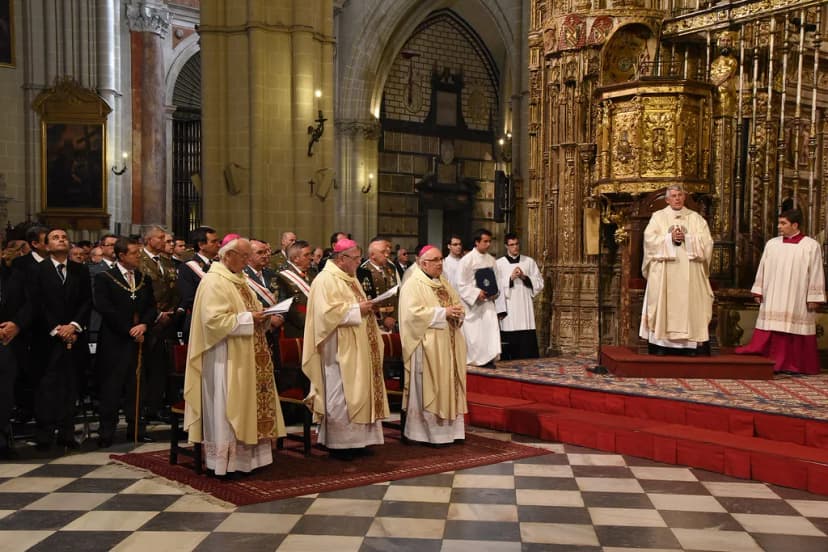
Easter Decides What Your Spring Looks Like
More than any other Italian season, spring's shape depends on a date that moves. Easter can fall anywhere from late March to late April, and it drags a long chain of events with it — Carnival's ending, Holy Week, and two Venetian water festivals more than a month later.
| Event | Rule | Where |
|---|---|---|
| Carnival ends | Martedì Grasso, the day before Ash Wednesday | Nationwide |
| Holy Week | Palm Sunday to Easter Monday | Nationwide |
| Scoppio del Carro | Easter Sunday morning | Florence |
| Festa della Sensa | The Sunday after Ascension | Venice |
| Vogalonga | Pentecost Sunday | Venice |
The practical consequence: an early Easter pushes Holy Week into March, when the north is still cold and some coastal businesses have not reopened. A late Easter pushes it into a warm, fully-open late April. Both are called "spring", and they are materially different trips. Check where Easter falls before booking anything else.
Easter: The Densest Week in the Italian Calendar
Holy Week is the most concentrated religious programme Italy runs, and it is genuinely regional rather than a single national observance.
Rome is the obvious centre of gravity — papal liturgies, the Via Crucis at the Colosseum on Good Friday, and Urbi et Orbi on Easter Sunday. It is also the hardest week of the year to get near St Peter's, and accommodation prices behave accordingly.
Campania works completely differently. There is no single centre; the week belongs to neighbourhoods and islands, most remarkably Procida, where hand-built tableaux are carried through the streets before dawn on Good Friday. It is free, it is not staged for visitors, and it is one of the more extraordinary things that happens in Italy all year.
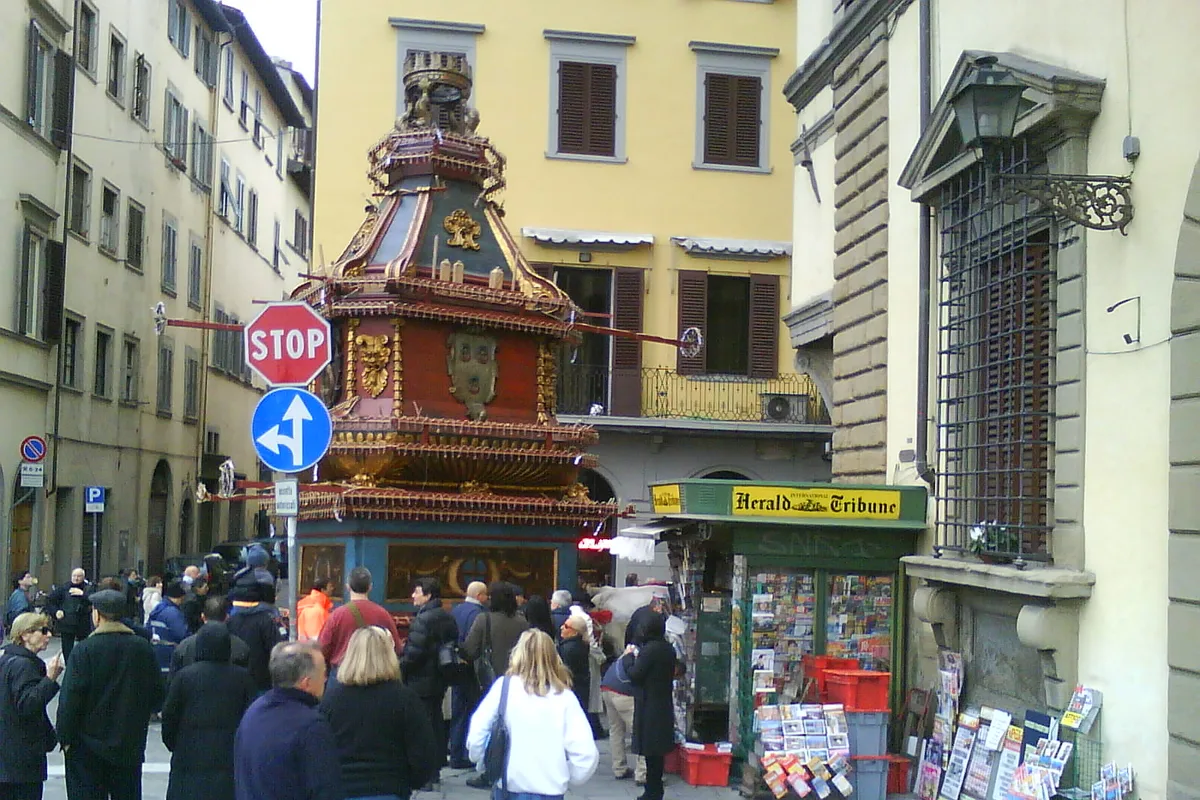
Florence does something else again. The Scoppio del Carro — the "explosion of the cart" — sends a mechanical dove down a wire into a firework-loaded cart outside the Duomo on Easter Sunday morning, a ritual the city has run in some form since the Crusades. The overview of how the regions differ is in Easter in Italy.
One planning note that catches people: Easter Monday, Pasquetta, is a national holiday, and Italians traditionally spend it out of town. Trains, motorways and day-trip destinations are busy; city museums are quieter than you would expect.
April: Design, Wine and a City's Birthday
April is when Italy's trade and cultural calendar restarts, and three of its events are large enough to reshape a city for a week.
Milano Design Week is the biggest. The Salone del Mobile runs at Rho Fiera while the Fuorisalone takes over courtyards, showrooms and palazzi across the city — and unlike the trade fair, most of the Fuorisalone is free and open to anyone. Milan is effectively full that week; book far ahead or stay outside the city.
Vinitaly in Verona is four days of Italy's largest wine fair at Veronafiere. It is a trade event first, but it runs alongside public tastings in the city, and it lifts hotel prices across Verona.
Natale di Roma on 21 April marks the city's mythological founding, with reenactments and processions across the nearest weekend. It is one of the few fixed-date spring events, and it is free.
Late April also brings COMICON Napoli, four days spanning into early May at the Mostra d'Oltremare, and the Maggio Musicale Fiorentino opera and concert season opens in Florence — despite the name, it runs roughly April to June rather than only in May.
May: The Month Italy Goes Outdoors
If one month justifies a spring trip built around festivals, it is May. The weather is reliable, the crowds have not arrived, and the calendar is dense with events that are local first and touristic second.
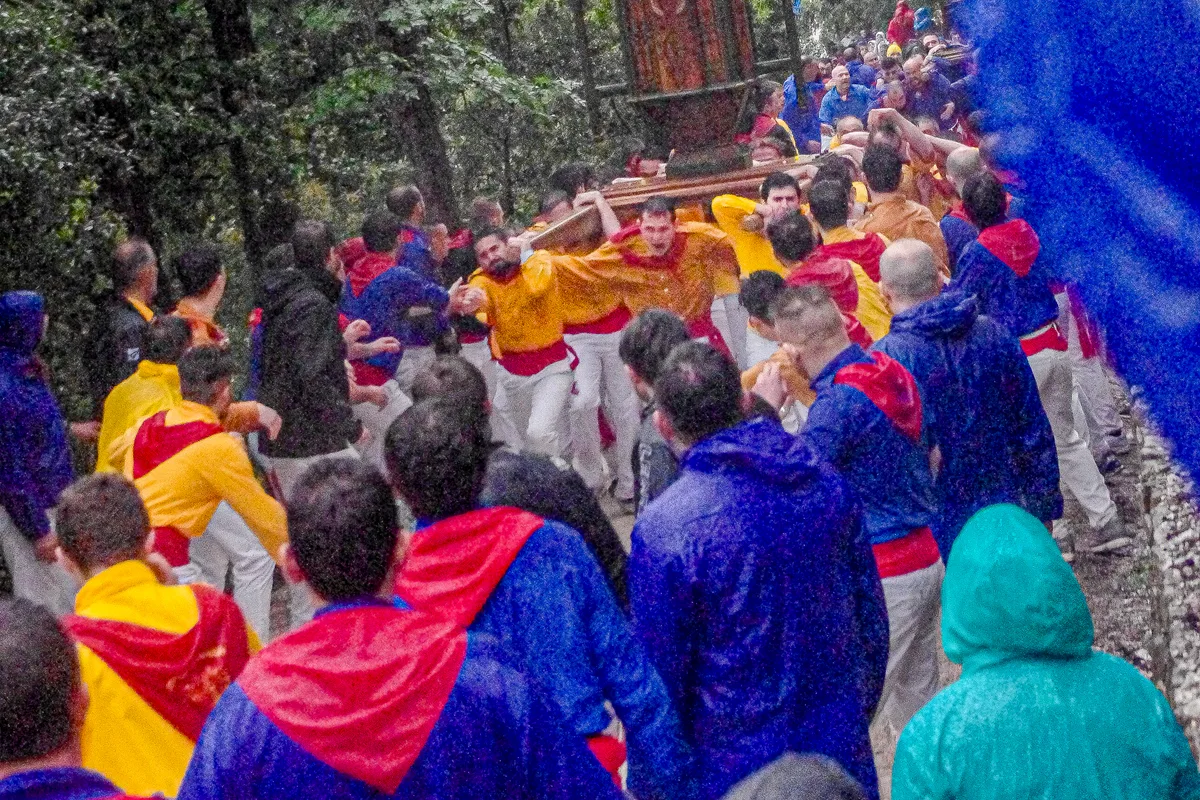
The Corsa dei Ceri in Gubbio runs on 15 May every year — one of the few genuinely fixed dates in the Italian calendar. Teams carry three enormous wooden ceri at a run through the town and up Monte Ingino. It is not a reenactment; it has been run continuously for centuries and the town takes it extremely seriously.
The Infiorata di Noto in Sicily falls on the third weekend of May, when Via Nicolaci is carpeted in flower petals laid into a designed composition. Venice contributes two water festivals whose dates move with Easter: the Festa della Sensa, the quietest of the city's water rituals, and the Vogalonga, a 30km non-competitive row through the lagoon on Pentecost Sunday.
Naples runs Maggio dei Monumenti from early May into June, opening buildings that are normally closed and programming events around them. Milan holds Piano City over a long weekend in mid-May, with hundreds of free piano performances in courtyards, apartments and parks across the city.
Best Spring Destinations, Month by Month
Spring rewards matching the destination to the month rather than picking one and hoping. Some places are at their best in the first cool weeks of March; others don't come into their own until May.
| Month | Destination | Best for | What to see |
|---|---|---|---|
| March | Rome | Crowd-free sightseeing | Highs near 17°C/63°F; shorter lines at the Vatican Museums, Colosseum and Roman Forum; cherry blossom in the city's parks |
| March | Sicily | Early-spring sun | Highs around 20°C/68°F; Agrigento's almond-blossom festival in the second week; the Valley of the Temples before the summer crowds |
| March | The Dolomites | Late-season skiing | Snow still falls at altitude; quieter slopes and shorter lift lines than midwinter, with long daylight for skiing and cross-country routes |
| April | Florence | Easter and gardens | The Scoppio del Carro; azaleas and wisteria at Villa Bardini; irises at the Giardino dell'Iris |
| April | Lago Maggiore | Spring flowers | Highs near 17°C/63°F; the Borromean Islands' terraced gardens in bloom; Villa Taranto's mid-April tulip week in Verbania |
| April | Venice | Spring calm | Generally sunny and mild; fewer day-trippers than summer; magnolias and wisteria in the city's gardens |
| May | Umbria | Hiking and wildflowers | The Piano Grande near Castelluccio in full wildflower bloom; Assisi's Calendimaggio medieval festival; the Corsa dei Ceri in Gubbio |
| May | Cinque Terre | Coastal walking | Highs near 22°C/72°F; the Sentiero Azzurro trail linking all five villages; Monterosso's lemon sagra on the third weekend |
These are starting points, not a complete list. The region table below covers the country more broadly, and the events already described in April and May often decide the itinerary on their own.
Where Spring Works Best
Spring is the season with the widest choice, because almost everywhere is open and almost nowhere is unbearable. That said, the regions do not peak simultaneously.
| Region | Best window | Why |
|---|---|---|
| Sicily and the far south | March–April | Warm first; hot and crowded by late May |
| Rome and Lazio | April–May | Comfortable before summer heat; Easter is the exception for crowds |
| Tuscany and Umbria | May | Countryside at its greenest, before the June coach season |
| Amalfi Coast and islands | Late April–May | Reopening completes; sea still cool but towns are functioning |
| Venice and the Veneto | April–May | Before the summer crush; the water festivals fall here |
| Alto Adige and the Alps | Late May | Snow clears late; hiking season has not properly started |
The one region to think twice about, outside a specific ski trip, is the high Alps. March still has skiing at altitude in resorts like the Dolomites, but once that season ends spring becomes the region's awkward gap — the lifts close, the hiking trails are not yet clear, and mountain refuges are largely shut. Alto Adige's valleys and towns are pleasant throughout, but the high country itself is between seasons until June.
What Spring Tastes Like
Italian menus turn over sharply in spring, and the change is more visible than in most cuisines because so much of the country still cooks seasonally by default.
Artichokes are the signature. Rome runs two preparations that are effectively civic institutions — carciofi alla romana, braised with mint and garlic, and carciofi alla giudia, flattened and deep-fried, from the Jewish quarter. Both are at their best from roughly February to April. Fava beans, peas and wild greens follow, and in Rome vignarola combines them into a stew that exists only for a few weeks. Further south, spring produce leans toward broad beans, garlic, lemons, strawberries and cherries; in the north, white asparagus, leeks, beets and spring greens fill the market stalls alongside the season's fresh cheeses.
Easter has its own fixed repertoire: lamb across most of the country, colomba — a dove-shaped cousin of panettone — nationwide, and regional specialities such as Naples' pastiera, a wheat-and-ricotta tart that appears for the season and then vanishes. Liguria's spring is defined by the first basil of the year and therefore by pesto.
The sagra circuit, Italy's system of small single-product town food festivals, is quieter in spring than in autumn but not absent — asparagus, strawberry and artichoke sagre run through April and May. How the system works is covered in food festivals and sagre in Italy.
Weather, and Why March Is Not May
Spring warms from the south upward, and the gap between the ends of the season is large. March in Milan or the Alto Adige is still effectively winter — cold, damp, with snow on higher ground. March in Sicily is already pleasant. By May the whole country is comfortable, and the south is beginning to get genuinely warm.
| Month | North | Centre | South |
|---|---|---|---|
| March | 41–55°F / 5–13°C, 10–12 rainy days | 46–59°F / 8–15°C, 8–10 rainy days | 50–64°F / 10–18°C, 6–8 rainy days |
| April | 40–60°F / 5–16°C — the wettest of the three regions | 50–65°F / 10–18°C | 55–65°F / 13–18°C |
| May | 50–70°F / 10–21°C — the coolest of the three | 55–70°F / 13–21°C | 60–75°F / 16–24°C — the warmest of the three |
Rain is the variable people plan for least. April is the wettest of the three spring months nationwide, and "April showers" translates reasonably well to the Italian spring. It rarely ruins a trip, but outdoor festivals do get moved or shortened, and a waterproof layer earns its space.
Exactly what has reopened for the season by any given week matters more than the thermometer if the coast is the destination — that is its own question, covered next.
What's Reopened by Spring, and What Isn't
Several of Italy's most popular coastal and seasonal destinations effectively close for winter, and each comes back to life on its own schedule rather than a fixed date. Knowing what stage of that reopening a place is at matters more than which month is on the calendar.
The Amalfi Coast, Capri, Puglia's Salento peninsula, and the Ligurian coastline between Porto Venere and Portofino can all be visited in March, but expect a partial town: most of the larger hotels, many restaurants and shops are still shuttered for the season, and tourism-built services — full ferry timetables, full-day boat tours — have not resumed. It is a legitimate way to see these places without the crowds, but arrive with adjusted expectations rather than a picture of a summer season in full swing.
By April, the picture changes. Regular ferry services and the coastal hiking trails of the Cinque Terre and the wider Ligurian coast pick back up, and most businesses that shut for winter have reopened. May completes it: by then the reopening is essentially finished everywhere except the high Alps, where mountain refuges and many cable cars stay closed until the summer hiking season properly begins.
What to Wear for an Italian Spring
Spring is the trickiest season in Italy to pack for, because the weather changes by the hour as much as by the month. The rule that holds across the whole season: dress in layers you can add and remove through the day rather than pick one outfit for it.
A light jacket or trench coat covers the crisp mornings and evenings that persist even once the afternoons have warmed up, and a packable rain jacket plus a travel umbrella earn their space — April is the wettest of the spring months, though the rain typically comes in short spurts rather than washing out a whole day. Underneath, button-downs, long-sleeve t-shirts, light sweaters and cardigans layer easily as the temperature shifts through the day. A scarf does double duty: warmth in the morning, and something to cover bare shoulders where a church requires it — many of Italy's churches, and some museums, ask visitors to cover shoulders and knees, and it catches people out.
Comfortable, broken-in walking shoes matter more than any other single item — Italy's historic centres are cobbled and best explored on foot, and water-resistant soles help on the rainy days. Jeans are worn everywhere in Italy and travel well for casual days; they are not out of place. A sunhat is worth packing if the south, or late May anywhere, is on the itinerary, since the midday sun there is already strong before summer arrives.
Costs, Crowds and the Value Window
Spring contains the best value in the Italian year, but not uniformly — two windows are genuinely expensive.
| Window | Cost | Why |
|---|---|---|
| March, before Easter | Low | Still shoulder season; coast partly closed |
| Holy Week and Easter | High | Rome especially; domestic and international travel peak |
| 25 April and 1 May | Elevated | Two national holidays that often bridge into long weekends |
| Milano Design Week | Very high in Milan | The city sells out; rates multiply |
| Mid-to-late May | Moderate | The sweet spot: good weather, pre-summer pricing |
Two national holidays sit inside spring: 25 April (Liberation Day) and 1 May (Labour Day). Both close offices and many shops, and when they fall midweek they generate ponti that empty the cities and fill the coast. The mechanics are covered in the guide to Italy's public holidays.
For the rest of the year, the Italy festival calendar maps what runs when. winter in Italy covers the season before this one and summer in Italy picks up where it ends.
Frequently Asked Questions
Is spring a good time to visit Italy?
It is arguably the best balance of the year. The weather is comfortable without the summer heat, coastal destinations reopen, and the festival calendar is dense — Easter, Rome's birthday on 21 April, and a May packed with local events. Prices stay below summer levels except during Holy Week and Milano Design Week.
What is the best month to visit Italy in spring?
May, for most trips. The weather is reliable across the whole country, the coast and lakes are fully open, summer pricing has not started, and the month carries fixed-date events including the Corsa dei Ceri in Gubbio on 15 May and the Infiorata di Noto on the third weekend. March is cheaper but still cold in the north with partial coastal closures.
When is Easter in Italy, and does it matter?
Easter moves between late March and late April, and it matters a great deal because a chain of events is tied to it — the end of Carnival, Holy Week, the Scoppio del Carro in Florence on Easter Sunday, and Venice's Festa della Sensa and Vogalonga more than a month later. An early Easter means a colder, partly-closed trip; a late one means a warm, fully-open one.
Is Italy crowded at Easter?
Rome is, intensely — Holy Week draws both pilgrims and tourists, and getting near St Peter's for the papal liturgies requires planning and patience. Elsewhere the pressure is lower and more local. Easter Monday, Pasquetta, is a national holiday when Italians travel out of the cities, so day-trip destinations and transport are busy while city museums are often quieter.
What should I pack for Italy in spring?
Layers and a waterproof. Spring warms from the south upward, so March in Milan or Alto Adige is still winter while Sicily is already pleasant, and April is one of the wetter months in much of the country. By May most of Italy is comfortable in light clothing, though evenings in the north stay cool.