Last updated August 2026. The Corsa dei Ceri in Gubbio happens every 15 May, when three teams haul roughly 800-pound wooden towers through Gubbio's stone streets and up Monte Ingino. Three saints, three guilds, and one fixed date make this the easiest Italian festival on the calendar to plan around. It sits in the same late-spring run as Noto's flower carpets and Pisa's Luminara on 16 June — three small towns, three completely different spectacles. This guide covers the timeline, the route, safety rules, and where the Ceri tradition shows up outside Umbria.
What Is the Corsa dei Ceri in Gubbio?
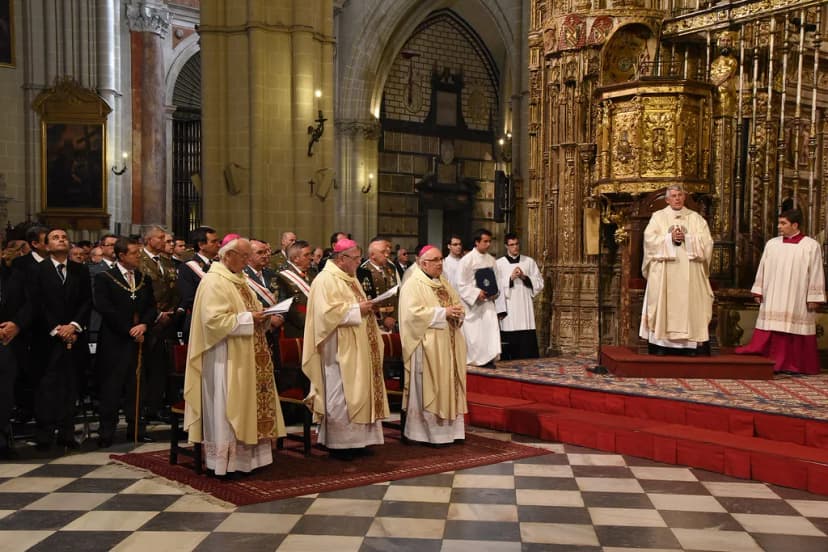
The Corsa dei Ceri is a foot race through Gubbio's medieval streets, held every 15 May, the eve of the feast of Sant'Ubaldo. Three teams each carry a Cero, a tall wooden octagonal prism topped with a saint's statue, from Piazza Grande to the Basilica di Sant'Ubaldo on Monte Ingino. Each Cero weighs roughly 800 pounds and stands about 13 feet tall, carried at a run on wooden handles by rotating crews. Sant'Ubaldo's team always enters the Basilica first, every single year. That outcome reflects Sant'Ubaldo's status as Gubbio's patron saint, not a competitive upset waiting to happen. Speed, coordination, and the skill of the climb decide the real contest, not whether Ubaldo's team can be caught. Historians trace the event to the 12th century, not long after Sant'Ubaldo died on 16 May 1160. Some scholars link the ritual to a 1151 military victory credited to his intercession. Others connect it to older devotion tied to the Roman goddess Ceres, whose Latin name may explain the word Ceri itself. Pope Celestino III canonized Ubaldo in 1192, and his relics moved to the church on Monte Ingino in 1194, cementing the uphill procession that continues today. A town statute from 1338 required guild representatives to join the Luminaria, the wax-offering procession that preceded the modern run. By 1458, records already describe the ceri as wood covered in colored wax, marking the shift from offering to structure.
The Three Teams: Colors, Saints, and Guilds
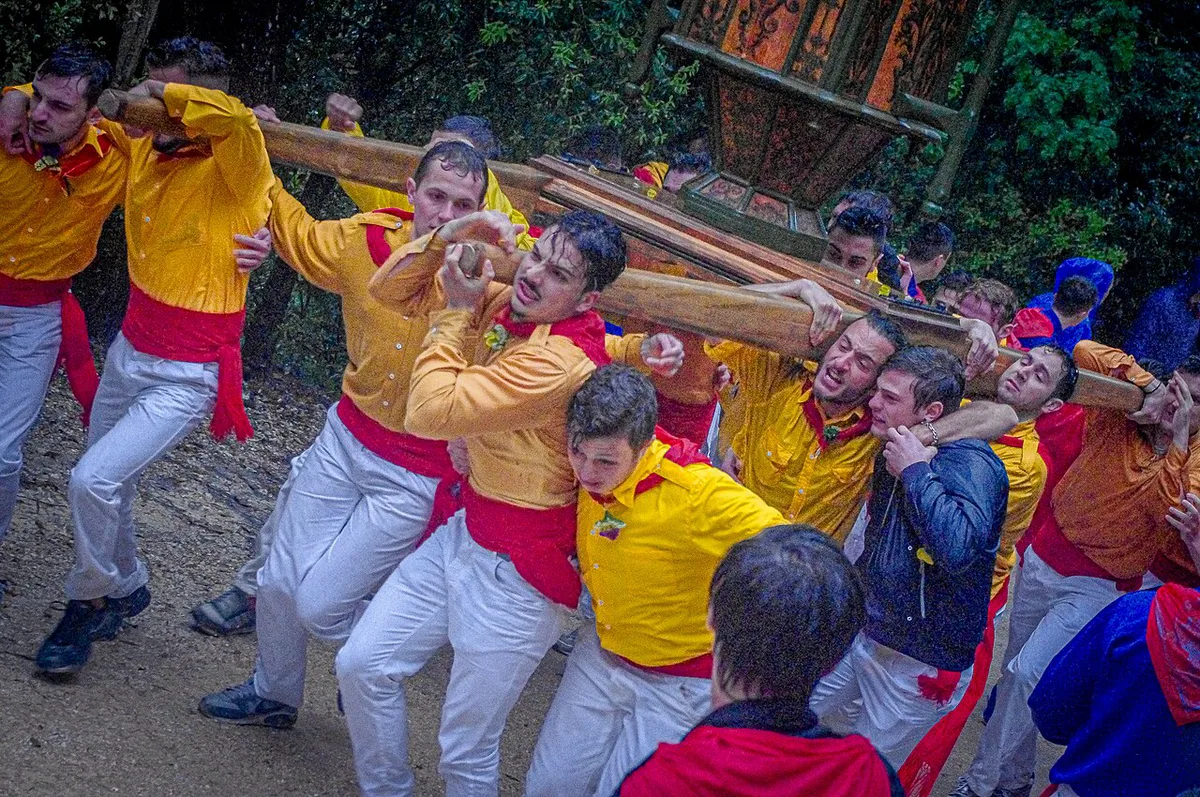
Each Cero belongs to a saint, a color, and a historic guild. Sant'Ubaldo's team wears yellow and traces back to the Università dei Muratori, Gubbio's stonemasons and construction workers guild. San Giorgio's team wears blue and represents merchants and shopkeepers. Sant'Antonio Abate's team wears black and represents farmers and donkey drivers, a nod to the animals once used to haul goods through the hills around Gubbio. Loyalty to a team runs through families for generations. Ceraioli, the men who carry the Ceri, often follow a parent's or grandparent's color rather than choosing one. Visitors are welcome to wear a team's color for the day, a simple way to signal support without joining the run itself.
- Sant'Ubaldo (yellow): Università dei Muratori, Gubbio's stonemasons' guild; always first into the Basilica.
- San Giorgio (blue): the merchants' and shopkeepers' guild.
- Sant'Antonio Abate (black): farmers and donkey drivers.
15 May: From the Alzata to the Corsa
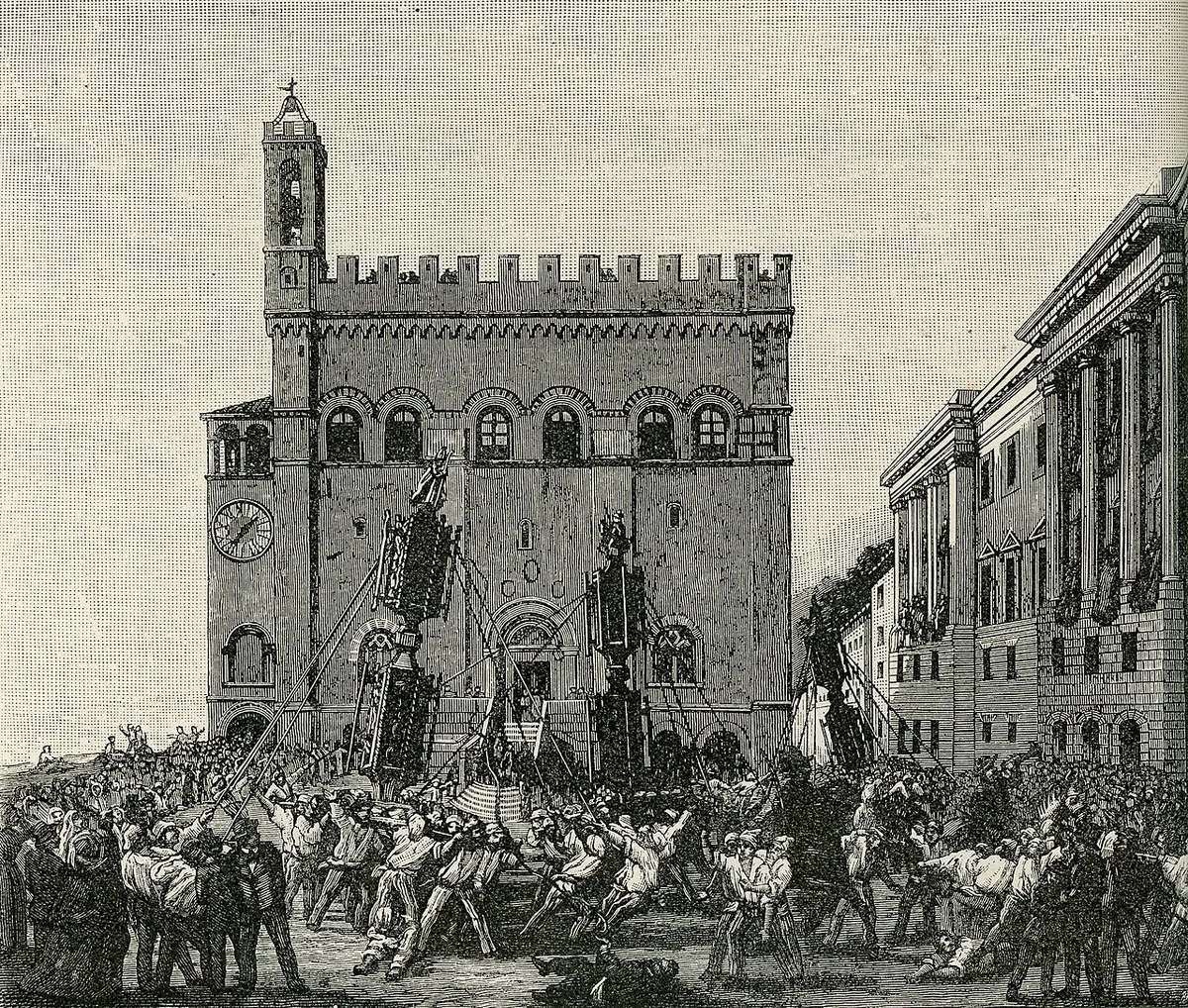
The day splits into two distinct events, hours apart in mood and speed. Morning brings the Alzata, the raising, when each team lifts its Cero upright in Piazza Grande in front of the Palazzo dei Consoli. Crowds gather early to watch the structures shift from horizontal to vertical, a slow, deliberate operation compared with what follows later in the day. Teams throw ceramic jugs, called brocche, into the crowd during the morning rituals. Catching a shard is considered good luck, and spectators scramble for pieces. Evening brings the Corsa itself. Once released, the three teams sprint the Ceri out of the piazza, through Gubbio's narrow streets, and up the final steep pitch of Monte Ingino to the Basilica. A rider clears the crowd ahead of the runners. Move back the moment you hear that signal approaching. Exact clock times shift slightly year to year, so confirm the day's schedule on Gubbio's comune site or ceri.it before you plan your position.
The morning Alzata emphasizes ritual and luck through brocche-throwing, while the evening Corsa demands full-speed precision: runners exchange positions every 75 to 100 yards, timed to prevent the structure from slowing or tipping.
| Phase | Time of Day | What Happens | Best For |
|---|---|---|---|
| Alzata | Morning | Ceri raised upright in Piazza Grande; brocche thrown to the crowd | Families, photos, a calmer crowd |
| Corsa | Early evening | Full-speed run through the streets and up Monte Ingino | High-energy viewing, experienced spectators |
The Route: From Piazza Grande to the Basilica di Sant'Ubaldo
The Corsa covers about 2.5 miles, starting at Piazza Grande and finishing at the Basilica di Sant'Ubaldo, perched atop Monte Ingino above the town. The Palazzo dei Consoli, Gubbio's medieval town hall on Piazza Grande, anchors the start. Crowds pack the square and the streets leading away from it long before the Corsa begins. Runners move through Gubbio's narrow medieval streets before the route turns uphill for the final climb to the Basilica. Carrying an 800-pound structure at a run is only possible because of the muta, the swap system that lets crews exchange places without breaking stride. Fresh runners slot in roughly every 75 to 100 yards, timed precisely so the Cero never slows or tips. Watching a muta happen at full speed is one of the clearest signs of how much coordination the event demands. Streets along the route narrow fast, and the crowd near Piazza Grande and along Via dei Consoli fills in hours ahead of the run.
UNESCO Heritage: The Rete delle Grandi Macchine a Spalla
Gubbio's Ceri belong to the Rete delle Grandi Macchine a Spalla, a network of Italian towns whose festivals center on tall, shoulder-borne processional structures. The Festa dei Ceri is documented as part of that network, grouping Gubbio alongside other Italian towns that carry comparable structures through their streets each year. Several towns in that network already carry individual UNESCO intangible-heritage recognition for their own festivals. The network itself formed partly to advocate for shared recognition of the whole group. Since 1973, the three Ceri have also served as an official symbol of Umbria, appearing on its regional coat of arms and flag. That regional status is separate from the UNESCO network link, but both point to the same fact: this is a recognized part of Italy's living folk heritage, not a local curiosity.
In 1973, the three Ceri gained official status as symbols of Umbria, appearing on the region's coat of arms and flag, but the tradition's cultural weight extends far beyond official recognition—it persists through family loyalty, with ceraioli inheriting their team colors across generations.
Planning Your Visit: Arrival, Parking, and Where to Stand
Gubbio is a walled hill town with limited internal parking, and the historic center largely closes to vehicle traffic on 15 May. Arrive four to five hours before the Alzata for a clear spot in Piazza Grande or along the route, since the square fills early. Public parking sits outside the walls, in the lower town, with a walk or shuttle up to the center. Book accommodation in Gubbio or a nearby Umbria town well before May, since rooms fill months ahead of the date. Wear sturdy, closed-toe shoes. The route runs over cobblestones and finishes on a steep uphill grade, and sandals or thin soles make the climb harder than it needs to be.
- Arrive 4-5 hours before the Alzata for a usable viewing spot.
- Park outside the walls in the lower town; the historic center closes to vehicle traffic.
- Book Gubbio lodging well ahead of 15 May; rooms sell out for the date.
- Wear closed-toe, sturdy shoes for cobblestones and the Monte Ingino climb.
- Consider wearing yellow, blue, or black to show support for a team.
Spectator Safety and Etiquette: What to Avoid
The Corsa is fast, heavy, and crowded, and a few habits keep it safe for everyone. Never stand in the runners' direct path once the Corsa begins; the Ceri do not stop or steer around bystanders. Move back the moment you hear the mounted rider clearing the route ahead of the teams. Families, seniors, or anyone with limited mobility should look for raised steps or terraces along the route, where the crush is lighter than street level. Keep children close at all times. Crowds compress fast once the run starts, and a set meeting point helps if anyone gets separated. A fallen Cero is treated as a serious misfortune for the team and the town, not a spectacle. Respond the way locals do: with quiet concern, not cheering.
- Never stand in the runners' direct path once the Corsa begins.
- Move back immediately when the mounted rider signals the route is clearing.
- Choose raised steps or terraces for a safer view with children or limited mobility.
- Agree on a meeting point in case your group gets separated in the crowd.
The Ceri Beyond Gubbio: Jessup and Thann
Communities with ties to Gubbio have carried the Ceri tradition abroad. Jessup, Pennsylvania, home to generations of Umbrian emigrants, holds its own Ceri race modeled on Gubbio's original. Thann, in France, holds a related celebration built on the same emigrant connection. Neither event replaces a visit to Gubbio itself. Watching the Corsa dei Ceri in its home town, on streets the tradition has used for centuries, is a different experience from a diaspora version scaled to a smaller community.
Comparing the Ceri to the Palio di Siena and the Sartiglia
Gubbio's Ceri share traits with two other Italian traditions covered elsewhere on this site. The Palio di Siena horse race runs on team loyalty the same way the Ceri do. Contrade in Siena and guild-based teams in Gubbio are both inherited rather than chosen by most participants. The Sartiglia festival in Oristano shares a layered origin story with Gubbio, mixing religious devotion with older, pre-Christian roots. All three events reward advance planning around a single fixed date or a narrow seasonal window. None of them are staged for tourists. Residents run these festivals for other residents, and visitors are guests at something that would happen with or without an audience.
Who Leads the Ceri? Ceraioli, Capodieci, and Capitani
The ceraioli are not simply runners. They form organized teams responsible for lifting, carrying, stabilizing, and rapidly exchanging positions beneath each Cero.
Each saint’s team is directed by a Capodieci, a senior figure who coordinates the raising and movement of that Cero. During the Alzata in Piazza Grande, the Capodieci stands above the carrying frame and helps control the crucial lift. He also raises a ceramic brocca before it is broken, launching the scramble for lucky fragments.
The Capitani hold a broader ceremonial and organizational role across the Festa dei Ceri. They help maintain order, uphold traditional procedures, and represent the authority of the festival during its public rituals.
Along the route, groups of ceraioli form successive mute, or carrying shifts. Incoming runners replace tired carriers while the Cero remains upright and moving. These exchanges require rehearsed timing because sudden changes in balance can endanger the structure, carriers, and nearby spectators.
For trip-planning details, see Festa dei Ceri official source and Comune di Gubbio.
Frequently Asked Questions
When is the Corsa dei Ceri in Gubbio?
The date never moves: 15 May every year, the eve of Sant'Ubaldo's feast day on 16 May. Gubbio's Ceri are fixed to the calendar, expected each year computed from a recurrence rule that has held for centuries, unlike festivals tied to a moving weekend or a lunar date. Confirm exact start times for the Alzata and the Corsa on Gubbio's comune site or ceri.it as the date approaches, since clock times can shift slightly year to year.
Who wins the Corsa dei Ceri?
Sant'Ubaldo's team enters the Basilica first every year, without exception. That outcome is fixed by tradition, not contested during the run. The real competition plays out inside each team: speed, coordination, and how well the muta swaps hold up under the climb. Ask a local about who won, and expect a story about a team's performance, not a shock result.
What happens if a Cero falls during the Corsa?
Dropping a Cero is treated locally as a genuine misfortune, not just a missed finish. The event carries deep collective pride, known in Gubbio as orgoglio, built on centuries without a break in the tradition. Spectators are expected to respond with concern, not cheering.
Is it safe to watch the Corsa dei Ceri as a spectator?
Watching is safe if you keep clear of the runners' direct path and heed the mounted rider who clears the route ahead of each team. Crowds compress fast in the narrow streets, so families, seniors, or anyone with limited mobility should choose raised steps or terraces instead of street level. Give the Ceri and their crews a wide, unobstructed lane at all times.
How early should you arrive in Gubbio for the Corsa dei Ceri?
Plan to arrive four to five hours before the morning Alzata. Gubbio is a small walled town, parking is limited outside the walls, and Piazza Grande fills early. Arriving that far ahead secures both a parking spot in the lower town and a usable position for the day's events.
Can visitors take part in the Corsa dei Ceri?
Carrying a Cero is reserved for ceraioli, men tied to one of the three teams, often through family history. Visitors do not join a muta uninvited. Spectators take part by choosing a team's color, standing along the route, and following the run on foot outside the barriers where local stewards allow it.