Last updated July 2026. Luminara di Pisa lights the Arno each 16 June, when crews mount roughly 100,000 wax candles on wooden frames called biancheria and hang them across the city's riverside palaces. This tradition marks the eve of San Ranieri, Pisa's patron saint, and closes with a fireworks display over the river. It belongs to a small group of Italian towns that stage one extraordinary night a year — Gubbio hauls three wooden towers up a mountain on 15 May, and Noto carpets a baroque street in flower petals in the same window. Travelers based in Florence, about an hour away by train, can time a trip around it and pair the night with a broader Tuscan June itinerary.
What Is the Luminara di Pisa?
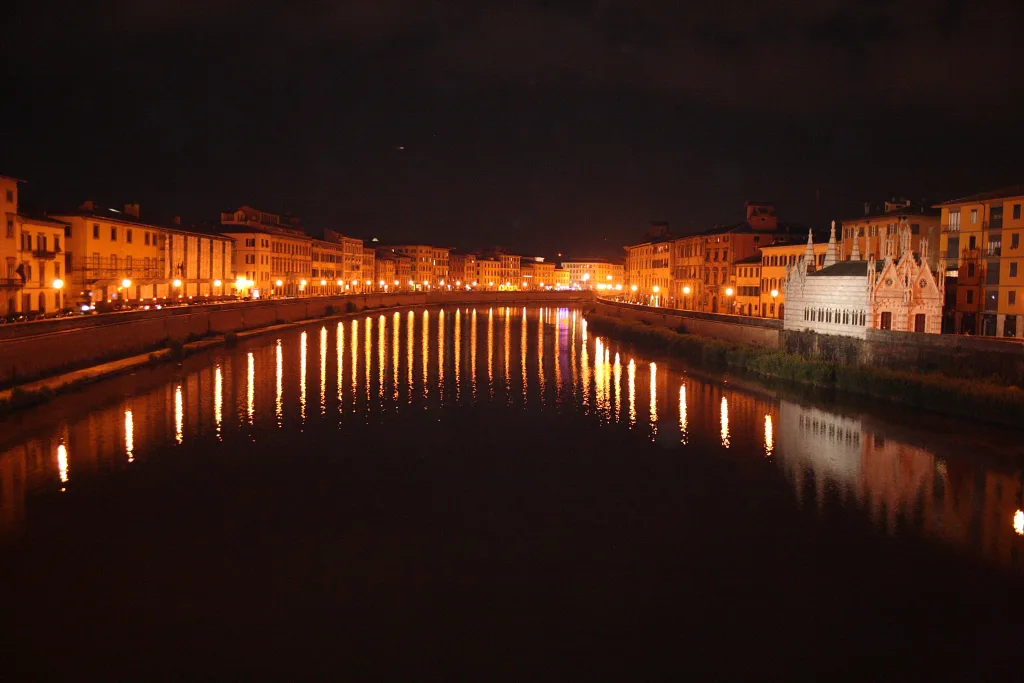
Luminara di Pisa refers to a single-night festival held every 16 June, the eve of the feast of San Ranieri. Pisa's patron saint gives the date its meaning, and the city marks the eve rather than the feast day itself with candlelight. Crews fix an estimated 70,000 to 100,000 lumini, small wax candles, onto wooden frames called biancheria that trace windows, cornices, and rooflines along the Lungarni. Historical records and Pisa's own tourism board cite figures across that range, so treat 100,000 as the commonly repeated round number rather than a precise count. Preparing the display takes about a hundred specially assigned workers, who thread candles into each biancheria frame through the afternoon. Since 1999, organizers have used cone-shaped transparent plastic cups instead of glass to hold each flame, a safety change from the display's earlier decades. A single supplier, the Cereria Graziani candle works founded in Livorno in 1805, has provided the wax lumini in recent years. Reflections on the Arno double the effect once public street lighting switches off at dusk. Pandemic closures paused the event in 2020 and 2021, and it returned in the years since. For a one-night detour from a Tuscany itinerary, the payoff is the transition itself: a city that looks ordinary at 2:00 PM and glows entirely by candlelight after dark.
Luminara di Pisa Timeline: From Afternoon Setup to Midnight Fireworks
Terre di Pisa, the city's official tourism board, listed the most recent program from 7:00 PM to 11:45 PM on 16 June, with candle-lighting work starting well before that public window. Four practical phases structure the evening below. Plan to be positioned along the river by the dusk phase, since foot traffic on the Lungarni thickens fast once the public lighting goes dark. That program has already passed by this update, so the practical planning question is the next edition. Expect 16 June 2027 for the following Luminara, computed from the festival's fixed recurrence on the eve of San Ranieri rather than confirmed by an official notice. Check Terre di Pisa's events page closer to spring for the confirmed program hours before booking travel.
| Time | What happens |
|---|---|
| 3:00 PM | Crews begin lighting the first of the biancheria candles along the Lungarni, between Ponte della Cittadella and Ponte della Fortezza, continuing until dusk. |
| Dusk | Public and private street lighting switches off, and the candlelit palace facades become the only light along the river. |
| 11:00 PM | A roughly 30-minute fireworks display launches from floating platforms on the Arno, traditionally near the Cittadella. |
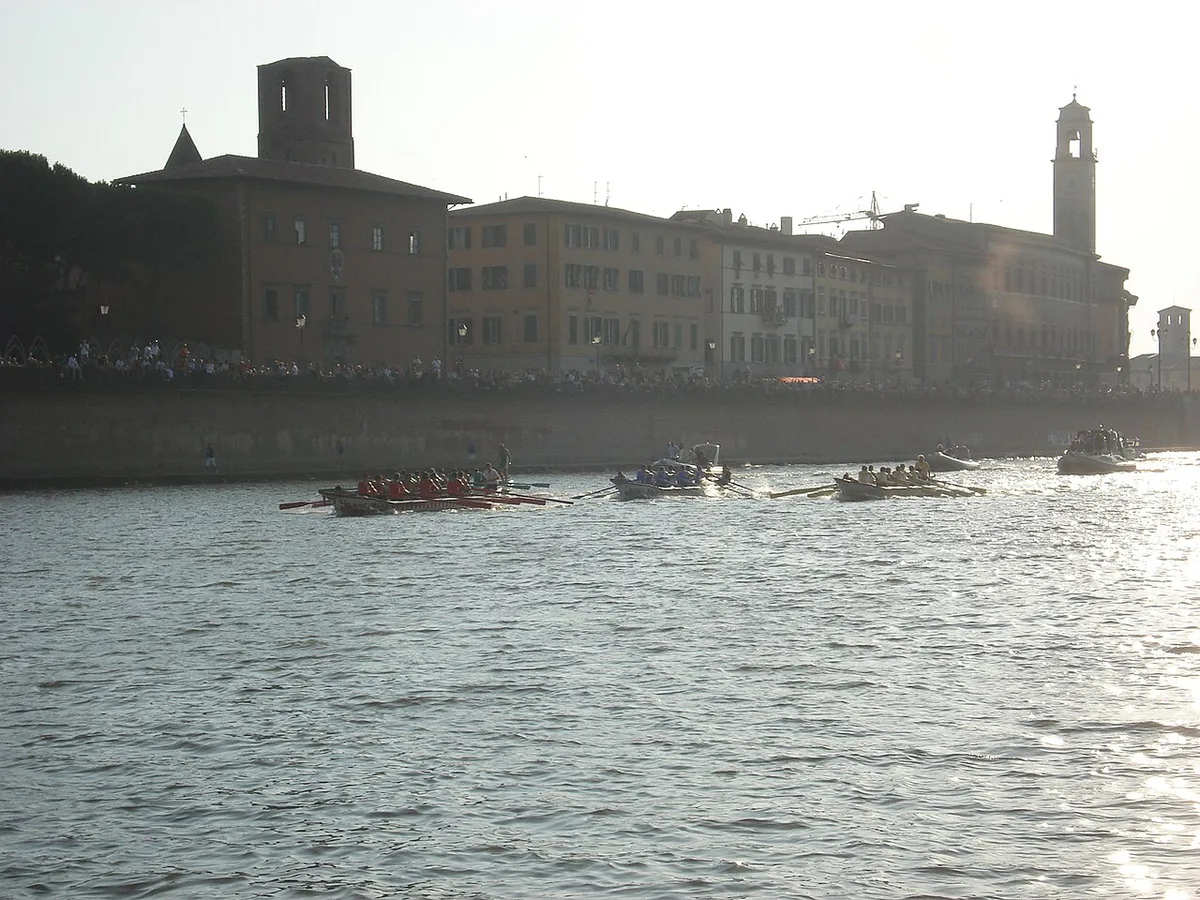
| 17 June | Regata di San Ranieri, a boat race among Pisa's four historic districts, closes out the two-day celebration. |
Getting from Florence to Pisa for the Luminara
Regional trains connect Florence Santa Maria Novella and Pisa Centrale in about an hour, with frequent daytime departures. Demand spikes on Luminara night as thousands of day-trippers head back after the fireworks, so late service runs thinner than the daytime timetable. Confirm the last return departure on Trenitalia's app before leaving Florence, and build in buffer time at the platform, since the crowd moves through the station all at once. Buying the return ticket in advance through the same app skips a line at the station's ticket machines during the post-fireworks rush. Both festivals sit inside the same June calendar. Florence's Calcio Storico tournament typically runs across the month. Pisa sits close enough by train that a Florence-based trip can sometimes fold in both events. Calcio Storico's exact match days shift year to year, while the Luminara stays fixed on 16 June, so confirm both events' current dates before building a combined itinerary.
- Pisa Centrale to the Lungarni: about a 10-15 minute walk.
- Corso Italia and Piazza Garibaldi choke first as the crowd funnels toward the river; side streets running parallel stay clearer.
- Borgo Stretto narrows early in the evening; treat it as a one-way route, not a shortcut back out.
Best Vantage Points Along the Lungarni and Piazza dei Miracoli
Lungarno Mediceo, Lungarno Pacinotti, and the other Lungarni streets carry the main event, with biancheria frames outlining windows, cornices, and towers on both banks. Piazza dei Miracoli takes a different treatment. Oil lamps, called padelle ad olio, light the Leaning Tower and the city walls around the Duomo instead of the wax lumini used along the river, so that light reads warmer and more irregular. This style of building-outline lighting survives in only two Tuscan cities, Pisa's Luminara and Lucca's Santa Croce illumination in September, according to regional tourism sources. Terre di Pisa's own program describes candle-lighting work running along the Lungarni between Ponte della Cittadella and Ponte della Fortezza, and the fireworks platforms sit on the Arno in that same stretch.
- Lungarni (Lungarno Mediceo, Lungarno Pacinotti): the full biancheria display, with the best reflections on the water.
- Piazza dei Miracoli and the city walls: oil-lamp lighting on the Leaning Tower, a different visual from the candlelit palaces along the river.
- Ponte della Cittadella and Ponte della Fortezza: the closest fireworks viewing, since the display launches from platforms on the Arno between them.
Should You Day-Trip or Stay Overnight in Pisa?
Tolerance for a late train versus tolerance for event-night hotel rates drives the choice. Trade-offs between the two options appear below. A middle option exists for travelers who want some of both: watch the fireworks, then catch a very late regional train rather than committing to a Pisa hotel room. Rooms near the center for the night of 16 June are booked out months ahead in a typical year, so decide on an overnight stay as early in the trip-planning process as possible.
| Factor | Day trip from Florence | Overnight in Pisa |
|---|---|---|
| Cost | Lower: only the round-trip train fare | Higher: event-night lodging rates, booked out months ahead |
| Transit stress | Real: late trains thin out after the 11:00 PM fireworks | None: no late train to catch |
| Atmosphere | Ends once you leave for the station | Extends past midnight into the emptier post-fireworks glow |
| 17 June bonus | Requires a separate trip | Same-stay access to the Regata di San Ranieri |
Costs and Access on Luminara Night
Admission costs nothing for the Luminara itself. Candlelit palaces along the Lungarni, the lit Piazza dei Miracoli, and the fireworks show are all free, open-air, and unticketed. Budget instead for the incidentals around the event. Trains between Florence and Pisa carry a published one-way regional fare; check Trenitalia's app or site for the current price before travel, since fares are reviewed periodically. Street food and café tables along the route to the Lungarni run at typical Pisa pricing on a normal night. Expect a premium at stalls closest to the crush zones near Borgo Stretto. Travelers arriving by car should budget for parking outside the historic center, since the ZTL zone and event-night closures rule out driving directly to the Lungarni. If staying over, compare the same hotel's rate for 16 June against its rate for a non-event night earlier in June. That gap between the two numbers is the real cost of an overnight stay, more informative than any flat estimate. Because the event stays free, total trip cost scales mostly with transit choice and whether you stay the night, not with the festival itself.
San Ranieri and Giugno Pisano: The Story Behind the Candles
San Ranieri degli Scacceri, Pisa's patron saint, died in 1161 and is remembered each June across a set of events grouped under Giugno Pisano. Its origin story dates to 25 March 1688. That day, Cosimo III de' Medici had San Ranieri's relic urn moved into the Cappella dell'Incoronata inside the Duomo di Pisa. Pisa marked the translation with a citywide illumination that became an annual custom. Historians note an even earlier documented reference to the candlelight tradition from 1337, so the 1688 relic ceremony likely formalized a custom that already existed in some form. The custom has not run uninterrupted. Authorities abolished it in 1867. It returned in 1937 alongside the revived Gioco del Ponte contest, then paused again through World War Two. Celebrations resumed for the 1952 feast of San Ranieri. Flood damage collapsed the Ponte Solferino and long stretches of the Lungarno in 1966, forcing another pause. It did not return until 1969. Giugno Pisano also includes the Gioco del Ponte, a historic bridge contest, alongside the Luminara. Regata di San Ranieri, held the following day, pits four crews named for Pisa's historic quarters, San Francesco, Sant'Antonio, San Martino, and Santa Maria, in a race that finishes with each crew's bowman climbing a pole to grab the palio flag mounted on a barge midstream. Florence offers two comparison points in the same season. Maggio Musicale Fiorentino: A Traveler's Guide to Florence's Opera Season brings opera and classical programming rather than street pageantry. 9 Things to Know About Calcio Storico in Florence matches the Luminara's folk energy with a costumed, physical contest staged in Florence's piazzas.
The candlelight tradition documented from 1337 survived abolition, war, and flood. Today it remains admission-free, yet Pisa lodging for Luminara night books out months ahead—demonstrating how even ancient customs can face modern scarcity despite their enduring heritage.
Mistakes to Avoid at the Luminara di Pisa
A few planning mistakes repeat every year among first-time visitors.
- The 3:00 PM lighting phase turns bare biancheria frames into full candlelight in real time. Arriving only after dark means missing that transition entirely.
- Pisa's ZTL limited-traffic zone already restricts private cars in the center on a normal day. On Luminara night the Lungarni also close to traffic, so park outside and walk in, or arrive by train instead.
- The Luminara draws a large student and local crowd. Expect a high-energy street festival, not a quiet candlelight vigil.
- Waiting too long to decide between a day trip and an overnight stay. Pisa lodging for 16 June sells out months ahead, and undecided travelers often end up with neither a hotel room nor a confirmed late train.
Crowd-Smart Viewing and Exit Routes
Ponte di Mezzo and Piazza Garibaldi form the busiest central pinch point. Corso Italia and Borgo Stretto also become slow-moving funnels before the fireworks.
For more space, continue west along Lungarno Pacinotti toward Ponte della Cittadella. The eastern stretches near Lungarno Mediceo and Ponte della Fortezza offer another alternative to the central bridge. Both areas retain river reflections and views toward the fireworks zone.
Choose your riverbank before dusk because crossing later can be difficult. Florence-bound travelers should favor the south bank for a simpler walk toward Pisa Centrale. From Lungarno Gambacorti, use streets south of the river instead of joining the Corso Italia surge.
- Avoid Ponte di Mezzo if easy movement matters more than a centered view.
- Stand near the edge of your chosen Lungarno rather than inside a bridge approach.
- Arrange a meeting point away from Piazza Garibaldi in case your group separates.
- After the fireworks, wait briefly or leave before the finale if catching a fixed train.
The city walls and Piazza dei Miracoli provide atmospheric lighting with less pressure than the central Lungarni. However, they do not offer the same direct river-level fireworks view.
For trip-planning details, see Luminara di San Ranieri official source and Pisa Unica Terra tourism board.
Continue planning with Palio di Siena: 8 Things to Know Before You Go.
Frequently Asked Questions
When is the Luminara di Pisa held?
Luminara di Pisa falls on 16 June every year, the eve of the feast of San Ranieri. Organizers fix the date rather than announce it annually, so 16 June 2027 is the expected next edition based on that recurrence, pending confirmation from Terre di Pisa closer to the date.
Do you need tickets for the Luminara?
No ticket is required. Every part of the Luminara, including the candlelit Lungarni, Piazza dei Miracoli, and the fireworks show, takes place in open streets and is free to attend.
How many candles light up Pisa during the Luminara?
Sources cite figures between roughly 70,000 and 100,000 wax lumini, mounted on wooden biancheria frames along the Lungarni. Treat 100,000 as the commonly repeated round number rather than an exact official count.
Is it better to day-trip from Florence or stay overnight in Pisa?
A day trip costs less and skips booking Pisa lodging. Late trains back to Florence run thin after the 11:00 PM fireworks, so plan that leg with care. Staying overnight costs more, since rooms near the center sell out months ahead, but it removes the late-train pressure and adds same-stay access to the Regata di San Ranieri the next day.
Where is the best place to watch the fireworks?
Position along the Lungarni near Ponte della Cittadella or Ponte della Fortezza, since the display launches from platforms on the Arno in that stretch. Arrive well before 11:00 PM, since the riverside fills in early once the candles are lit.