Last updated August 2026: calcio storico is Florence's 50-minute, 27-a-side hybrid of rugby, wrestling, and street fighting, played in Renaissance costume on a sand-covered Piazza Santa Croce. Four historic quartieri compete each June, and the rivalry between neighborhoods runs deeper than any single match — the same contrada-style loyalty that drives the Palio di Siena 70km south, where seats are sold by private building owners rather than by the city. This guide breaks down the ticket process and the fixed 24 June final date so you can decide whether to attend; the rules guide sets out exactly what is and is not permitted on the sand. That date is no accident: the final is played on the feast of San Giovanni, Florence's patron saint day, which closes with fireworks over the Arno the same night. See the Florence festival calendar for the rest of the year.
What Is Calcio Storico Fiorentino?
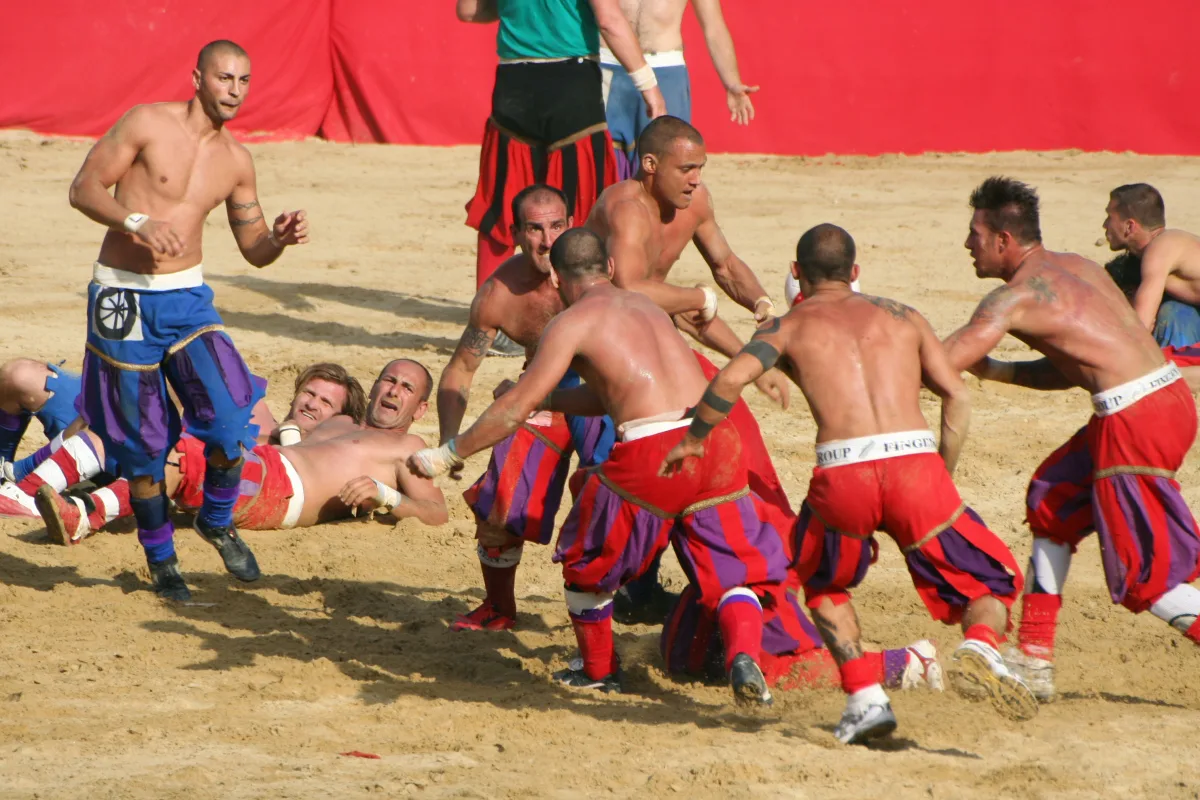
Calcio storico is a 16th-century hybrid of rugby, wrestling, and football, played each June in Piazza Santa Croce. Two teams of 27 players compete for 50 minutes, with no substitutions allowed after an injury or an expulsion. A head referee, six linesmen, and an off-field judge commissioner oversee play, though most disputes get settled between players before officials step in. Florence's own word for the sport, calcio, later became the standard Italian word for soccer. Those four positions add up to the full 27-player roster fielded by each quartiere. One Florence culture publication describes the tournament as Il Gioco Sanguinoso, the bloody game, and the tactics on the sabbione back up the label. Following past incidents of serious foul play, eligibility rules were tightened: players generally must be born in Florence or have lived there for at least ten years, and those with criminal convictions are excluded.
| Position | Italian Name | Players Per Side |
|---|---|---|
| Goalkeepers | Datori indietro | 4 |
| Fullbacks | Datori innanzi | 3 |
| Halfbacks | Sconciatori | 5 |
| Forwards | Corridori | 15 |
Where the Rivalry and the Violence Come From
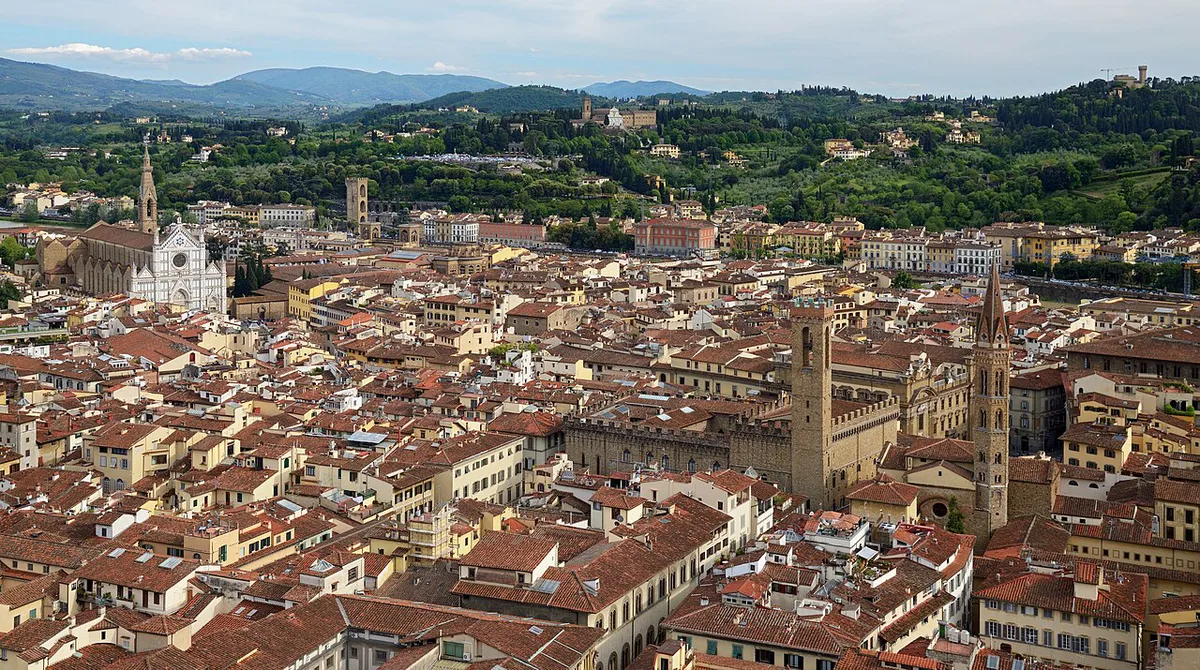
The game is thought to descend from harpastum, a Roman ball sport played with a smaller ball. Florentines documented an early match in 1470, and by the late 1400s, impromptu games filled the city's streets and squares. Florence's most famous match took place on 17 February 1530. Florentine soldiers defending the besieged Republic played calcio in Piazza Santa Croce, in defiance of Emperor Charles V's troops camped on the surrounding hills. Giovanni de' Bardi, a Florentine count, published the first written rules in 1580. According to a line often attributed to France's Henry III in 1574, the sport was too small to be a real war and too cruel to be a game. Even Florentine-born popes reportedly played calcio while in Rome, among them Clement VII, Leo XI, and Urban VIII. Interest faded through the 17th and 18th centuries, and the tournament was revived in 1930, timed to the 400th anniversary of the 1530 siege match, under the Kingdom of Italy. The tournament has been cancelled outright in several seasons after brawls spiraled beyond the referees' control. That legacy is why Italians still call soccer calcio nationwide, a linguistic trace back to matches once staged on this same piazza.
Choosing a Quartiere: The Four Teams of Calcio Storico
Each of Florence's four historic quartieri fields its own team, and loyalty typically follows birthplace rather than choice. Visitors without a hometown claim can pick a side based on where they're staying or which colors they prefer. Santo Spirito's Bianchi represent the Oltrarno, the district south of the Arno, while San Giovanni's Verdi take their name from the cathedral square at the city's core. Santa Croce's Azzurri have been the tournament's most successful side since 1979, with more than 20 titles, including the 2026 final. Their closest modern rivals, Santa Maria Novella's Rossi, have picked up multiple wins across the past two decades. It's not uncommon to see quartiere flags and photos of past calcianti displayed year-round in neighborhood bars and restaurants.
| Quartiere | Neighborhood | Color | Home Church |
|---|---|---|---|
| Azzurri | Santa Croce | Blue | Basilica di Santa Croce |
| Rossi | Santa Maria Novella | Red | Basilica di Santa Maria Novella |
| Bianchi | Santo Spirito | White | Basilica di Santo Spirito |
| Verdi | San Giovanni | Green | Duomo / Battistero di San Giovanni |
9 Things to Know About Calcio Storico Fiorentino
Beyond the history and team colors, a handful of practical details separate calcio storico from a standard sporting event. These specifics matter most when deciding whether to attend in person. None of them show up clearly in a quick search, which is exactly why they trip up first-time visitors.
- Scoring Works Differently Than You'd Expect
- Points, called cacce, are scored by getting the ball into the opposing net, which runs the full width of the piazza at each end.
- Teams switch ends after every caccia scored, and throwing the ball over the net rather than into it earns the opposing side half a caccia.
- A Cannon and a Ceremonial Toss Start Play
- A small cannon, the colubrina, fires to announce kickoff and each goal scored.
- Play begins when the pallaio, the ceremonial ball-carrier, throws the ball toward the center line.
- What's Allowed, and What Isn't
- Head-butting, punching, elbowing, and choking are standard tactics, not violations.
- Sucker punches, kicks to the head, and multiple players ganging up on one opponent are banned; breaking these rules means expulsion.
- The referee, considered the master of the field, steps onto the sabbione only to restore discipline when fights spiral out of control.
- Someone's Job Is to Cool Down the Fighting
- A designated aquaiolo circles the sabbione throwing water on players to cool them off and break up extended pileups.
- The Pitch Is Sand, Not Grass
- Piazza Santa Croce is covered in sand for the tournament, a surface known as the sabbione.
- The field measures roughly 109 by 55 yards, about 100 by 50 meters, with a white line dividing it into two equal squares.
- The Prize Is a Cow, Not a Trophy
- The winning quartiere takes home a Chianina calf, the prized Tuscan cattle breed, rather than a conventional trophy.
- The Final Comes With a Renaissance Parade
- On final day, the Corteo Storico della Repubblica Fiorentina, a procession of more than 500 people in Renaissance dress, sets out from Piazza Santa Maria Novella at 3:45 PM.
- It reaches Piazza Santa Croce by around 5:00 PM, and the match kicks off at 6:00 PM.
- All four quartieri march in the parade, even the two that aren't playing in that day's match.
- Fireworks Close Out the Feast of San Giovanni
- After the final, fireworks light up the Arno from Piazzale Michelangelo, closing out the day's celebrations.
- You Can Watch Without a Ticket
- Local channel Toscana TV broadcasts live from the afternoon, with an evening replay.
- Delayed streaming coverage is also available through DAZN as a paid rebroadcast, and Piazza Santa Croce's surrounding streets and bars carry plenty of atmosphere on match day even without a seat inside.
What It Feels Like Inside Piazza Santa Croce
Match day has a distinct atmosphere well before kickoff. Fans fill the piazza dressed in their quartiere's color, some with painted faces or torn shirts, and flag displays unfurl from the stands as rival sections needle each other. Acrid-smelling smoke bombs are common in the crowd, briefly tinting sections of the piazza in team colors. Chants of Forza! echo through the crowd as the two finalist teams' supporters try to out-shout each other before the ball is even in play. Modern calcianti are amateurs with day jobs, among them teachers, tradespeople, and marketing consultants, who train together at each quartiere's own sports complex year-round.
When Is Calcio Storico? The Fixed 24 June Final and Next Match Dates
Matchups for the two semifinals are decided on Easter Sunday, during the city's Scoppio del Carro celebrations. The Scoppio del Carro, literally the explosion of the cart, is Florence's own Easter Sunday tradition, and the calcio storico draw takes place alongside it. Four colored marble eggs, one per quartiere, are drawn from a velvet pouch. Whichever two colors come out first play each other, and the remaining two form the second pairing. Semifinals are typically held on a single weekend in the first half of June. In the most recent edition, they fell on 13 and 14 June, with the final following on 24 June. That final date does not move. It is fixed to 24 June every year, the feast of San Giovanni Battista, Florence's patron saint, so it counts as confirmed by the recurrence rule rather than a fresh yearly announcement. Next season's semifinal weekend is expected in mid-June, based on that recurrence pattern, but exact dates are typically confirmed only after the Easter Sunday draw. Treat any semifinal date you see before that draw as expected rather than confirmed, and check it against the fixed 24 June final.
The 24 June final always kicks off at 6:00 PM, following a Renaissance parade departing Piazza Santa Maria Novella at 3:45 PM.
Calcio Storico Tickets: Why They're Harder to Get Than They Look
Calcio storico is built for locals first, and the ticketing system reflects that. Since 2018, tickets have sold through the physical box office rather than online only, so Florence residents get a fair shot before tourists do. Boxoffice Toscana, on Via delle Vecchie Carceri, hands out queue numbers starting at 9:00 AM on release days. Arriving well before 9:00 AM is common, since queue position determines who reaches the ticket window before allocations run out. Online sales open through TicketOne roughly one to two weeks before each match, and listings have sold out within minutes in past seasons. Box office purchases require an electronic debit or credit card; American Express is not accepted. Local guides describe it as a game by locals and for locals, comparable in local intensity to Siena's Palio horse race. Those figures reflect the most recently published final-day pricing; confirm current rates on TicketOne before each new sale window opens, since prices are typically not published far in advance. Semifinal tickets run slightly cheaper, with Tribuna C priced at €50 rather than €53 in the same season. Demand is highest for the 24 June final, since both finalist quartieri's fans compete for the same limited stands. Each buyer has generally been limited to four tickets per transaction, and refunds are not issued for postponed matches or for matches called off after the 15-minute mark.
| Stand | 2025 Final-Day Price |
|---|---|
| Curve colori (standing) | €29 |
| Tribuna C (sun-side) | €53 |
| Tribuna Onore Laterale (shaded) | €82 |
Mistakes to Avoid on Match Day
A few common missteps are avoidable with basic planning.
Choosing the mid-priced €53 Tribuna C means sitting in direct sun, while the priciest €82 side stand offers shade; bring water if prioritizing lower ticket costs.
- Underestimating the Heat
- Late June in Florence regularly brings intense midday heat, and most of the stands around Piazza Santa Croce offer no shade.
- The mid-priced Tribuna C stand sits in direct sun, per its Italian nickname tribuna al sole; only the priciest side stand is shaded.
- Bring water and sun protection, and expect to be seated well before the 6:00 PM kickoff since gates and security checks add time.
- Expecting a Family Soccer Match
- This is a physically brutal contest, not a youth-league game; expect visible blood, forceful takedowns, and open fighting.
- Reconsider attending in person if you or the people you're with are sensitive to depictions of combat.
- Wearing the Wrong Colors in the Wrong Streets
- Rival quartiere fans fill the streets around Piazza Santa Croce before and after matches, and the rivalry is genuine, if usually good-natured.
- The tightest crush typically happens right after the final whistle, as fans pour out of the stands into the surrounding streets at once.
- Avoid wearing a rival team's colors deep in another quartiere's territory on match day.
- Assuming Rain Cancels the Match
- Matches typically proceed regardless of weather, and a wet sabbione turns to mud rather than stopping play.
Is Calcio Storico Right for You?
Calcio storico rewards travelers looking for an unfiltered local tradition, but it isn't for everyone.
| You'll likely enjoy it if | Consider skipping it if |
|---|---|
| You want to see a genuine Florentine tradition, not a staged show for tourists. | You're hoping for a relaxed, family-style afternoon out. |
| You can handle open physical violence, including blood and forceful hits. | You or the people you're with are sensitive to combat sports. |
| You're comfortable queuing for tickets or watching from a screen if seats sell out. | You need guaranteed advance seating with no risk of a sellout. |
Beyond the Match: Other June Events Near Florence
Calcio storico is not the only reason to plan a June trip around Florence. Nearby Pisa marks its own patron saint feast on 16 and 17 June with the Luminara di Pisa: A Complete Guide to Pisa's Candlelight Festival, a riverside lantern tradition along the Arno. Back in Florence, the Maggio Musicale Fiorentino: A Traveler's Guide to Florence's Opera Season runs through the same season. Its register is entirely different: opera, orchestral concerts, and staged classical performances rather than sand and combat. Luminara falls about a week before the calcio storico final, and Maggio Musicale's season overlaps both events, so June scheduling can combine all three with a bit of route planning. Pairing the two events gives a trip both the grit of calcio storico and a quieter cultural counterpoint. June is the strongest month of the Italian summer — the Italian summer season maps the rest of it. The match sits inside Estate Fiorentina, the city's summer programme of open-air events running from June into September.
For trip-planning details, see Calcio Storico Fiorentino official source and Italian National Tourism Agency.
Frequently Asked Questions
How do you get tickets to calcio storico?
Tickets are sold two ways: online through TicketOne, which tends to sell out within minutes, and in person at Boxoffice Toscana on Via delle Vecchie Carceri. Its in-person line hands out queue numbers from 9:00 AM and is generally the more realistic option for visitors. Payment at the box office must be by electronic debit or credit card; American Express is not accepted. Each buyer is generally limited to four tickets per purchase.
When is the calcio storico final?
Every year, the final is fixed to 24 June, the feast of San Giovanni Battista. Semifinals are expected in mid-June, following the pattern of recent years, but exact dates are confirmed only after the Easter Sunday marble-egg draw.
Is calcio storico appropriate for children?
Many Florentine families do bring children, and locally it's treated as a normal part of growing up in the city. Expect visible blood and open fighting, though, so sensitive children may find it distressing.
What happens if it rains during calcio storico?
Matches typically proceed regardless of weather. Rain turns the sand pitch, the sabbione, into mud, which slows play down without stopping it.
Can you watch calcio storico without a ticket?
Yes. Local channel Toscana TV broadcasts live from the afternoon with an evening replay, and streaming coverage runs through DAZN. Piazza Santa Croce's surrounding streets and bars also carry plenty of atmosphere on match day even without a seat inside.
June in Florence and Pisa
Two cities an hour apart put their biggest nights in the same fortnight.