

Last updated August 2026. Most visitors meet the contrade as teams in a horse race, which gets the relationship exactly backwards. The contrade are permanent civic institutions — seventeen of them, each with its own territory, elected government, constitution, church, museum and patron feast — and the Palio is a thing they do twice a year. Understanding that inversion is the difference between watching a race and understanding a city.
What a Contrada Actually Is
The word contrada simply means "district" or "ward" in Italian. In Siena it means something more specific: a district with its own territory inside the city walls, and — this is the part that surprises people — its own local government, elected officials, statute and jurisdiction within those boundaries. Each has a flag, a symbol, a set of colours, a patron saint, a church, a museum holding its own Palio banners, and a fountain where its infants are baptised into membership.
Membership is not chosen and not resigned. Everyone born or living in Siena belongs to a contrada, and the affiliation is lifelong. The Sienese formulation is blunt about the hierarchy: you belong first to your contrada, then to Siena, and only then to Italy.
The Seventeen Contrade, by Name
Every district takes its name and emblem from an animal or symbol, and that emblem is what you actually see on flags, plaques and lamp-posts as you cross from one territory into the next: Aquila (Eagle), Bruco (Caterpillar), Chiocciola (Snail), Civetta (Owl), Drago (Dragon), Giraffa (Giraffe), Istrice (Porcupine), Leocorno (Unicorn), Lupa (She-Wolf), Nicchio (Seashell), Oca (Goose), Onda (Wave), Pantera (Panther), Selva (Forest), Tartuca (Tortoise), Torre (Tower) and Valdimontone (Ram).
Siena is split first into three larger thirds, or terzi — Camollia to the north, Città to the south-west, and San Martino to the south-east — and the seventeen contrade sit inside those three older divisions. Knowing a district's animal is the fastest way to read the city: the same eagle, caterpillar or she-wolf reappears on everything from doorway plaques to the corner fountain.
Why Seventeen, and Where They Came From
The districts were organised in the Middle Ages to raise and supply troops for the military companies Siena hired while fighting to keep its independence from Florence and its other neighbours. Their governing structure survives as a genuinely democratic one: each contrada still elects its own council from among its residents.
There were originally around fifty-nine of these districts; consolidation over the centuries reduced them to the seventeen that survive. Some of the names that disappeared still surface in Siena's street names and local lore — Gallo (rooster), Leone (lion), Orso (bear), Quercia (oak), Spadaforte and Vipera (viper) are among the contrade that no longer exist as independent districts.
That military origin explains a great deal about how the survivors still behave. The rivalries are territorial and inherited rather than sporting, several contrade carry formal, centuries-old enemies, and the emotional register around the Palio is closer to a civic conflict than to a sports fixture. The boundaries are real lines on real streets, marked by the emblems and colours you see on plaques and lamps as you walk through the city.
From Bullfights to the Palio
The rivalry between contrade needed an outlet long before there was a horse race. For centuries it played out in bullfights, staged partly because they drew wealthy visitors to the city. The processions that preceded those fights — built around floats and chariots shaped like animals — are thought to be where several contrade picked up the symbols and names they still carry today.
Siena banned bullfighting in 1599. Buffalo races took over first, and by the middle of the seventeenth century those had given way to the horse races that became the Palio — a name borrowed from the pallium, the banner handed to the winner. Straight-line horse races with a pallium prize had existed as far back as the 12th century, but they ran between fixed points rather than the circuit of the Campo that defines the race today.
What now looks like a two-day event is really the visible tip of a six-month cycle. Preparations formally open on the last Sunday of April with a festival marking the return of spring, and continue through a calendar of ceremonies and neighbourhood banquets that builds toward race day.
How Ten Contrade Are Chosen to Run
There isn't room in the Campo for all seventeen districts to race at once, so each Palio fields only ten. Seven spots go automatically to the contrade that did not run the corresponding race — 2 July or 16 August — the previous year. The remaining three places are decided by lot. All seventeen are still pulled into the run-up regardless of whether they're racing, which is why the city feels charged even in a year a given district sits out.
The jockeys who actually ride are typically hired from outside Siena, often from Sardinia, rather than drawn from within the contrada system itself — an arrangement meant to keep the fierce inter-district politics out of who ends up in the saddle.
Alliances and Rivalries Between Contrade
Most contrade carry a declared ally and a declared adversary, formal relationships that shape everything from Palio-day tactics to who gets invited to whose feast-day table. The pattern isn't uniform. Lupa and Oca have no official ally at all; Bruco, Drago, Giraffa and Selva have no declared adversary. Torre sits at the other extreme — it answers to two rivals, Oca and Onda, the only contrada carrying a double enmity.
These pairings aren't recent inventions; most trace back generations, tied to old territorial disputes or, in a handful of cases, to a single flashpoint Palio that soured relations permanently. An allied contrada riding well is almost as satisfying as your own district winning; a rival's victory, even when your own horse never had a chance, can sting for a year.
None of this shows up on a map, but it explains a good deal of what you'll see on the ground during Palio season — flags flown together on adjoining balconies, or conspicuously not, and neighbourhoods that seem to shadow-box each other even when neither is racing that day.
The Baptism at the Fountain
Membership in a contrada begins, literally, at the fountain. Babies born to Sienese families are "baptised" into their contrada there, in a ceremony that — despite feeling ancient — is actually a relatively recent tradition layered onto a much older institution. From that point on, the child belongs to the district for life.
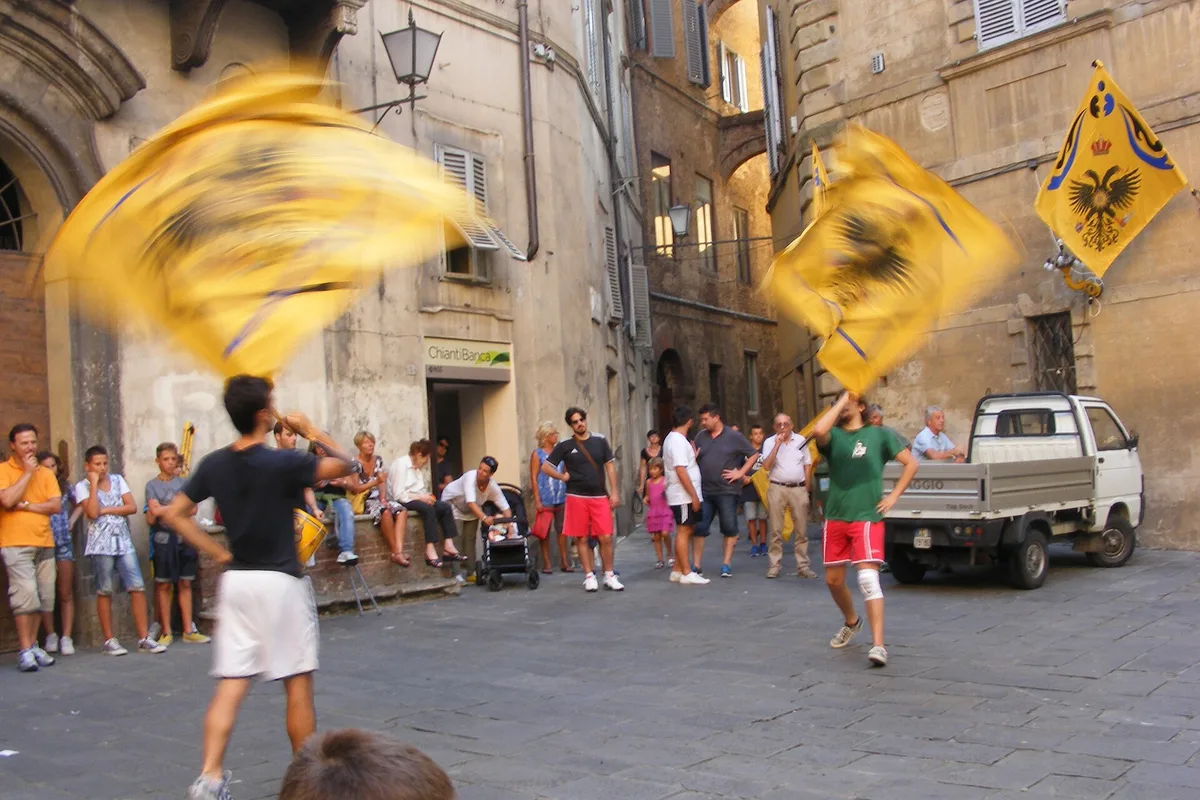
The contrada takes that membership seriously well before Palio age. Each runs its own activities for children, including the rough equivalent of a summer camp, alongside the flag-throwing and drumming practice you'll see teenagers rehearsing in side streets in the months before a race. It's this cradle-to-grave involvement, more than the race itself, that makes contrada identity function as a genuine second citizenship.
What Visitors Can Actually See
Contrada life is not staged for visitors, but a great deal of it is visible if you know what you are looking at.
| What | Access |
|---|---|
| Territory markers, emblems and colours | Open — walk the boundaries |
| Contrada churches and fountains | Generally visible from the street |
| Contrada museums | By arrangement, not walk-in |
| Feast-day processions | Open, unticketed |
| Communal dinners | Invitation and membership only |
- Territory markers — emblems, colours and plaques on buildings mark where one contrada ends and the next begins. Walking the boundaries is a genuine way to read the city.
- Contrada museums — each centres on a Sala delle Vittorie, a room of victories hung with the Palio banners the district has won over the centuries, alongside costumes and other historical material. Access is generally by arrangement rather than walk-in; enquire in advance.
- Churches and fountains — every contrada has its own church, where the horse assigned to it is blessed before it runs, and its own baptismal fountain; both are usually visible from the street.
- Feast days — each contrada has its patron saint's day, spread across the calendar, with processions and communal dinners in the streets.
- Long tables — the outdoor communal dinners before and after the Palio are the most visible expression of contrada life, and the hardest to attend without an invitation.
The honest caveat: this is a living social structure, not an attraction. Contrada dinners, museum visits and internal ceremonies operate on invitation and relationship. Visitors see the surface, and the surface is genuinely worth seeing — but nobody buys a ticket into a contrada.
When Contrada Life Is Most Visible
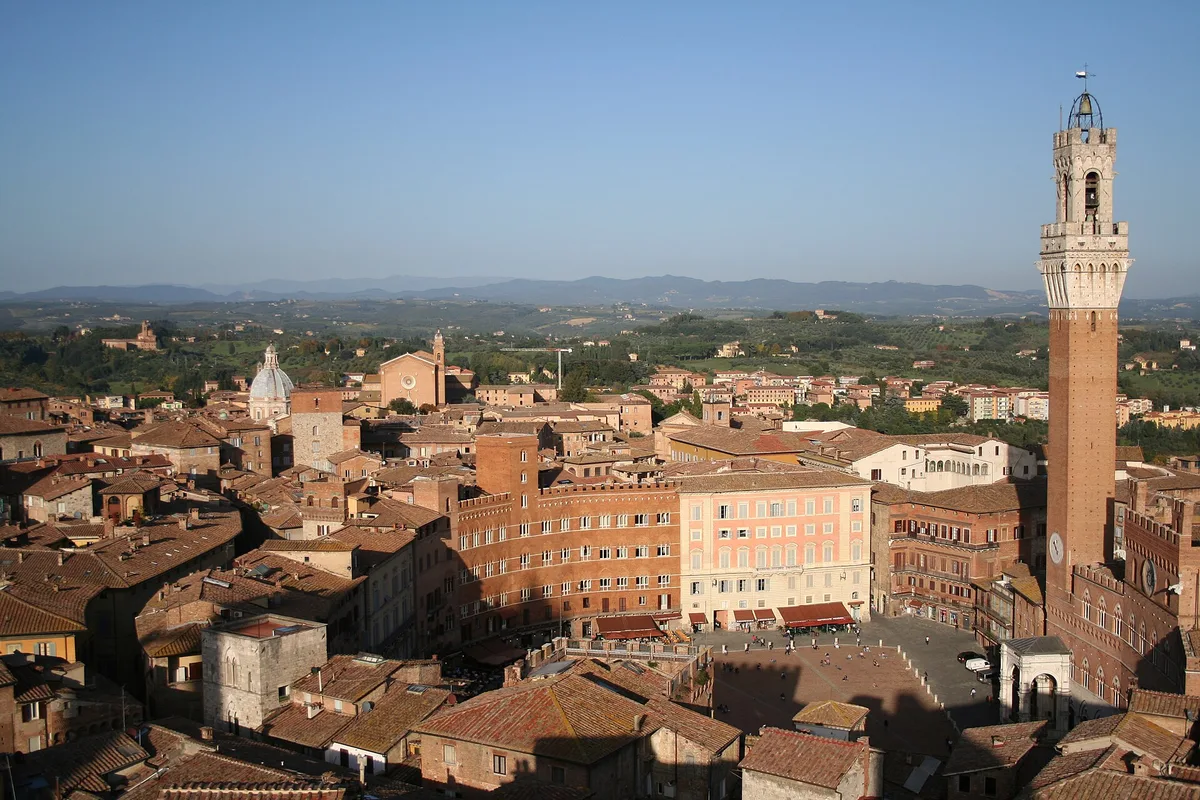
The obvious answer is Palio week — the days around the 2 July and 16 August races, when flags go up across the city, trial heats run in the Campo, and the long tables appear in the streets. It is also the hardest and most expensive time to be in Siena, and viewing the race itself is a logistical problem of its own.
The less obvious answer, and the better one for most travellers, is the contrada feast days scattered through the rest of the year. They are quieter, unticketed, and much closer to how the system actually operates day to day. The Comune and the Palio's own information site publish the calendar.
Siena's other summer draw is entirely separate from all this: the Chigiana International Festival runs classical concerts from July into September, largely for a different audience. The Siena festival calendar covers the year.
How Siena Compares
Nothing else in Italy works quite like this. Florence's Calcio Storico also runs on neighbourhood rivalry, and the quartieri there are historic, but it is a tournament with a season rather than a permanent parallel civic structure. Ivrea's Battle of the Oranges organises the town into teams, but for carnival rather than for life.
Siena's contrade are closer to permanent institutions that happen to hold a race — they run mutual aid, social life, baptisms and funerals. That is why the Palio's intensity is not explicable from the race itself, and why two minutes of horse racing can carry a year of consequence.
Frequently Asked Questions
What is a contrada in Siena?
A district of Siena with its own territory inside the city walls, plus its own elected government, statute, flag, patron saint, church, museum and baptismal fountain. There are seventeen, and everyone born or living in Siena belongs to one for life.
Why are there 17 contrade?
They were organised in the Middle Ages to supply troops for the military companies Siena hired while defending its independence from Florence and other neighbours. There were originally around fifty-nine; consolidation over the centuries left the seventeen that remain.
Do all 17 contrade run in the Palio?
No. Ten run in each race — the seven that did not run in that month the previous year, plus three drawn by lot. All seventeen are caught up in the build-up regardless, which is why the whole city feels involved even when a district is not racing.
Can visitors attend contrada events?
Partly. Street processions, feast days and territory markers are visible to anyone. Contrada museums generally require arrangement rather than walk-in access, and the communal dinners operate on invitation. This is a living social structure rather than an attraction.
How do you tell which contrada you are in?
By the emblems, colours and plaques on the buildings and street fittings, which change at the boundary. Each contrada also has its own church and fountain within its territory, both usually visible from the street. Walking the boundaries is one of the better ways to read Siena.