

Last updated August 2026. Calcio storico is routinely described as having no rules, which is wrong and makes it harder to follow. It has a written ruleset, match officials and a scoring system — the rules simply permit a great deal that other sports forbid. This page sets out what is legal, what is banned, how points are scored, and who enforces it, so you can watch a match and understand what you are looking at.
The Basic Shape of a Match
Two teams of 27 — the calcianti, as the players are known — play for 50 minutes on a sand pitch laid temporarily over Piazza Santa Croce, roughly 100 metres long by 50 wide. There are no substitutions — if a player is injured or expelled, his side plays short for the rest of the match. That single rule shapes everything else: with no replacements, a team that loses players to injury or expulsion is progressively outnumbered, and provoking an opponent into an expulsion is a legitimate tactic.
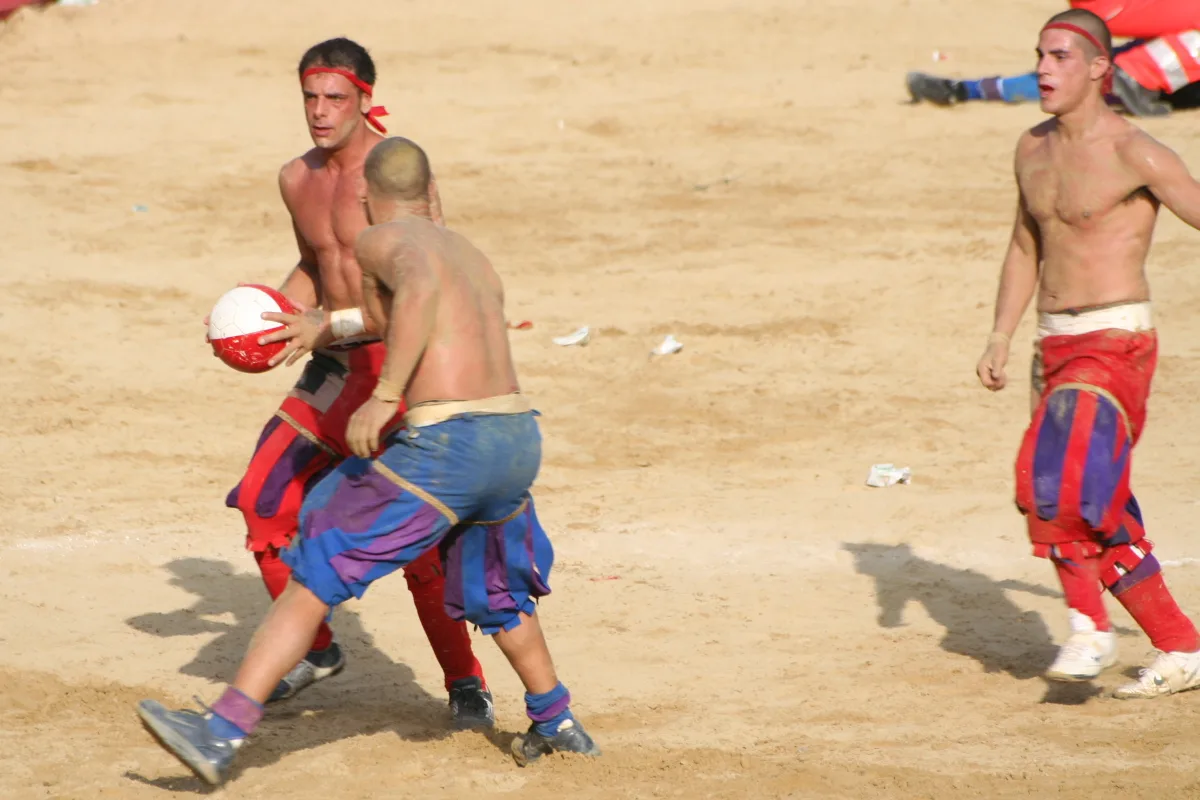
The sand matters more than it looks. It cushions falls, which is why players can be thrown without the pitch doing the damage, and it slows movement, so raw sprinting counts for less than strength and leverage. Florentines call this sand pitch the sabbione. A shot from a small ceremonial cannon, a culverin, marks the start of play, and the same signal fires again after every caccia — it's how the crowd knows the score has changed before the loudspeaker catches up.
What Is Allowed
The permissive list is what gives the sport its reputation, and it is genuinely broad.
- Punching, headbutting, elbowing and choking are all within the rules.
- Wrestling and grappling are permitted — a great deal of any match is two players simply trying to pin each other away from the ball.
- Hands and feet may both be used to carry, pass and control the ball, unlike association football.
- No offside. Players can position anywhere on the pitch at any time.
The consequence is that most of the pitch is not contesting the ball at all. Pairs of players lock onto each other across the sand, and the actual ball-carrying happens in whatever space that fighting opens up. Once you see the match as roughly two dozen simultaneous wrestling bouts with a ball moving through the gaps, it reads very differently.
What Is Banned
The prohibitions are few and specific, and they have tightened in the modern era after serious incidents.
- No kicks to the head. The clearest and most strictly enforced ban.
- No two-against-one. Ganging up on a single opponent is prohibited; fights are meant to be one-on-one.
- No hitting from behind. Striking or grabbing an opponent who cannot see the attack coming is banned, on the same reasoning as the sucker-punch rule.
- No sucker punches. Striking an opponent who is not engaged with you and cannot see it coming is out.
Enforcement leans on judgment as much as on the list itself. With multiple one-on-one fights running across the sand at any given moment, officials are watching for these specific violations rather than policing the wrestling as a whole — the hard part of the job is deciding when a fight has crossed from legal grappling into a banned strike, not whether the fight should be happening at all.
"No rules" is the phrase you will see everywhere, including on tickets and merchandise. What is true is that the list of prohibitions is short. What is false is that the match is unregulated — expulsions happen, and because there are no substitutions, an expulsion is one of the most damaging things that can happen to a side.
Who Can Play, and Are They Paid?
Eligibility is restricted rather than open, a change that followed past incidents of serious foul play. Players generally must have been born in Florence or have lived there for at least ten years, and anyone with a criminal conviction is excluded. Florence tried loosening this once: a rule permitting up to three foreign-born players per team was introduced and then scrapped, to keep the rosters distinctly Florentine.
The calcianti are not paid for taking part. There is no salary and no per-match fee — the pull is the neighbourhood rivalry and the history, not compensation. The closest thing to a prize is ceremonial: a calf of the Chianina breed, Tuscany's native cattle, is traditionally paraded into the piazza before the match as the symbolic prize for the winning side.

Scoring: the Caccia, and Why Missing Costs You
The entire far end of the pitch is the goal. A team scores a caccia by getting the ball over the opponents' end line — thrown or carried across the full width of that boundary, not into a net.
The critical detail, and the one that catches new spectators out: a throw that misses — going over the barrier without crossing the line correctly — awards half a caccia to the opposing side. That penalty for a wild attempt is why players so often carry the ball across rather than throw it from distance, and why a team leading late will refuse a speculative shot that a football side would take.
Teams change ends after each caccia. The side with the most cacce when the 50 minutes expire wins.
Positions and Officials
The 27 players are distributed across four positions, weighted heavily toward the forwards who do most of the fighting and running.
| Position | Italian | Per side |
|---|---|---|
| Goalkeepers | Datori indietro | 4 |
| Fullbacks | Datori innanzi | 3 |
| Halfbacks | Sconciatori | 5 |
| Forwards | Corridori | 15 |
Officiating is layered. A head referee, the Giudice Arbitro, runs the match on the sand, supported by six linesmen — with 54 players and several separate fights running at once, one official alone could not track every exchange, which is the practical reason that many pairs of eyes are needed. A Giudice Commissario sits off the field, and the Maestro di Campo oversees general order from outside the pitch — his role is closer to keeping the whole event under control than to adjudicating individual plays. In practice many disputes are settled between players before an official intervenes.
Watching a Match With the Rules in Mind
Three things to track once you know the ruleset. Watch the numbers: since nobody can be replaced, count how many players each side has lost and you will know who is winning the attrition even when the score is level. Watch the space behind the fighting, not the ball — that is where a caccia is set up. And watch for the half-caccia rule shaping decisions in the closing minutes.
For dates, ticketing, the four quartieri and what the day is actually like, see the main Calcio Storico guide — the final is always 24 June, the feast of San Giovanni, and finishes in time for the fireworks that evening. The nearest comparison in Italy is the Palio di Siena, which shares the neighbourhood-rivalry structure but almost nothing else. The Florence festival calendar covers the rest of the year.
Frequently Asked Questions
Does calcio storico really have no rules?
No — it has a written ruleset, match officials and a scoring system. What is true is that the list of prohibitions is short: kicks to the head, two-against-one and sucker punches are banned, while punching, headbutting, elbowing, choking and wrestling are all permitted.
How do you score in calcio storico?
By getting the ball over the opponents' end line, which spans the entire far end of the pitch — this is called a caccia. A missed attempt that goes over the barrier without crossing correctly awards half a caccia to the other side, which is why players usually carry the ball across rather than throw from distance.
How many players are on a calcio storico team?
27 per side: 4 goalkeepers (datori indietro), 3 fullbacks (datori innanzi), 5 halfbacks (sconciatori) and 15 forwards (corridori). There are no substitutions, so an injured or expelled player leaves his team a man down for the rest of the 50 minutes.
Who referees a calcio storico match?
A head referee, the Giudice Arbitro, on the sand with six linesmen, plus a Giudice Commissario off the field and a Maestro di Campo who oversees general order from outside the pitch. In practice many disputes are settled between the players before officials step in.
Who is allowed to play calcio storico?
Eligibility is restricted after past incidents of serious foul play. Players generally must have been born in Florence or have lived there for at least ten years, and those with criminal convictions are excluded.