Last updated August 2026. Every Easter Sunday morning, Florence tows a ten-metre wooden tower packed with fireworks into the gap between the Baptistery and the Duomo, and sets it off with a mechanical dove launched from the high altar. It is free, it takes about twenty minutes, and it is one of the strangest surviving rituals in Italy. This guide covers the running order, where to actually stand, and how the date moves.
When It Happens
The Scoppio del Carro takes place on Easter Sunday morning, every year without exception. Because Easter is computed from the ecclesiastical lunar calendar, the date moves between late March and late April — Easter Sunday 2027 falls on 28 March, computed from that rule rather than confirmed by any organiser.
What that means practically: the date is as certain as Easter itself, but the exact minute-by-minute programme is published by the city closer to the day and can shift. Treat the sequence below as the established pattern rather than a timetable to plan a train around.
The Running Order on Easter Morning
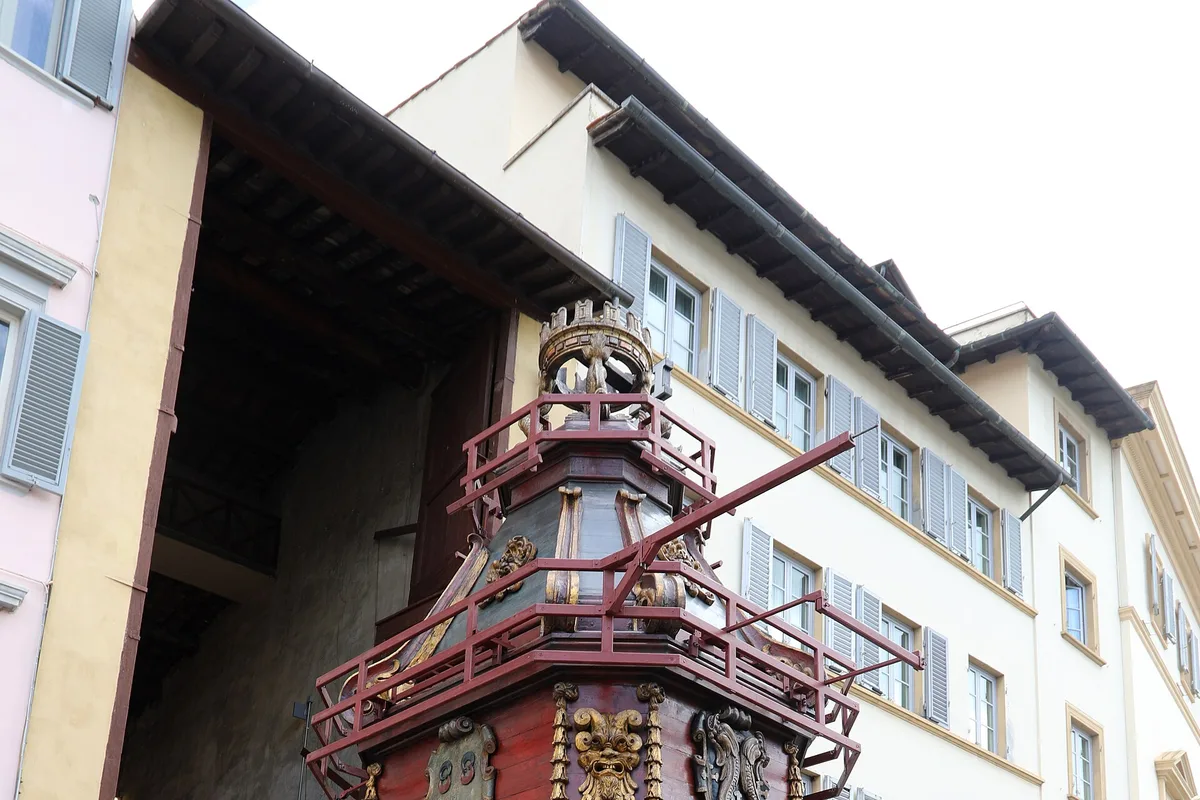
The morning follows a fixed sequence, and the interesting parts are earlier than most visitors expect. The cart itself — the Brindellone, a decorated wooden tower nearly ten metres tall — is hauled through the streets by a team of white oxen well before the explosion, and that procession is arguably the better photograph.
| Time | What happens | Where |
|---|---|---|
| ~10:00 | Historical procession arrives; the Brindellone is drawn into position | Piazza del Duomo |
| ~11:00 | The Colombina is lit during Mass and ignites the cart | Inside the Duomo, wire to the cart |
| ~11:00–11:20 | The cart burns and detonates upward through the tower | Between the Baptistery and the façade |
| ~12:30 | Gonfalone and Porta Fuoco procession leaves | Cathedral |
- Around 10:00 — the historical procession, in fifteenth-century costume, reaches Piazza del Duomo, with the Brindellone drawn into position between the Baptistery of San Giovanni and the cathedral
- Around 11:00 — during Mass inside the Duomo, the Colombina, a dove-shaped rocket, is lit from the high altar and runs down a wire to ignite the cart
- The cart burns and detonates in sequence for roughly twenty minutes, with the fireworks working upward through the tower
- Around 12:30 — the Gonfalone and the Porta Fuoco procession leave the cathedral, closing the ceremony
There is no admission charge and no ticket. The event is staged in a public square, which means access is decided entirely by when you arrive, not by what you booked.
Where to Stand
Piazza del Duomo is not a large square relative to the crowd it draws on Easter morning, and it is bisected by the cathedral itself. The cart sits on the western side, between the Baptistery and the cathedral façade, which means the usable viewing area is much smaller than the full piazza.
Arrive by 09:00 for a position with a clear line to the cart. Later than about 09:30 and you will be watching over heads or from a side street. If the procession is what you want rather than the explosion, position yourself along the route earlier and follow it in — the oxen-drawn cart moving through narrow streets is more photogenic than the detonation itself, which is mostly smoke at ground level.
One practical warning: this is a fireworks device going off at close range in an enclosed square. It is loud, sustained, and produces a great deal of smoke. Anyone sensitive to noise, and most small children, will have a better time watching from the edge of the piazza than from the front.
Where the Ritual Comes From
The tradition traces to the First Crusade. Pazzino de' Pazzi, of the Florentine banking family, is held by tradition to have been the first man over the walls of Jerusalem in 1097, and was rewarded with flints from the Holy Sepulchre. Those flints came back to Florence and were used to strike the holy fire distributed to the city's households at Easter — the cart evolved as the vehicle that carried that fire through the streets.
The agricultural reading matters as much as the religious one. A clean, complete burn was traditionally taken as an omen of a good harvest; a stuttering one, the reverse. That is why Florentines watch the sequence rather than just the finale, and why the ceremony is judged on whether it runs cleanly through.
Fitting It Into an Easter Trip
The Scoppio is a morning event that finishes around lunchtime, which leaves the rest of Easter Sunday open. That makes Florence a realistic Easter base in a way Rome is not — Holy Week in Rome demands most of the week and involves ticketed papal ceremonies, whereas Florence asks for one early start.
It also means the two are genuinely combinable. Florence and Rome are about ninety minutes apart by high-speed train, so a Holy Week trip can take in the Good Friday Via Crucis at the Colosseum and be in Piazza del Duomo on Easter morning. Further south, Campania does the week through confraternities and the dawn Misteri procession on Procida. Book that train well ahead — Easter weekend is one of the heaviest domestic travel periods of the Italian year, covered in the Easter in Italy guide. Florence's own calendar continues in June with the Festa di San Giovanni and Calcio Storico; the Florence festival calendar lays out the full year. Florence opens its year with another costumed procession, the Cavalcata dei Magi on Epiphany.
Frequently Asked Questions
When is the Scoppio del Carro?
Easter Sunday morning, every year. Because Easter is computed from the ecclesiastical lunar calendar, the date moves between late March and late April — Easter Sunday 2027 falls on 28 March by that rule. The detailed programme is published by the city closer to the day.
Do you need tickets for the Scoppio del Carro?
No. It takes place in Piazza del Duomo with no admission charge and no ticket. Access depends entirely on arrival time — aim to be in the square by 09:00 for a clear view of the cart.
What actually happens during the ceremony?
A ten-metre decorated wooden cart called the Brindellone is drawn by oxen to a spot between the Baptistery and the Duomo. During Easter Mass, a dove-shaped rocket called the Colombina is lit at the high altar and travels down a wire to ignite it. The cart then burns and detonates for around twenty minutes.
Where does the tradition come from?
From the First Crusade. Pazzino de' Pazzi is held by tradition to have been the first over the walls of Jerusalem in 1097 and was rewarded with flints from the Holy Sepulchre, later used to strike the Easter holy fire distributed across Florence. A clean burn was also read as an omen of a good harvest.
Can you combine it with Easter in Rome?
Yes. Florence and Rome are roughly ninety minutes apart by high-speed train, and the Scoppio is a morning event. A Holy Week trip can take in the Good Friday Via Crucis at the Colosseum and still reach Piazza del Duomo on Easter morning — but book trains well in advance, since Easter weekend is peak domestic travel in Italy.