Last updated August 2026. Carnival masks in Venice range from a plain black Bauta bought for a few euros to a hand-painted cartapesta piece signed by a named artisan, and the difference is obvious immediately. This guide separates the six classic mask styles worn during Carnevale di Venezia from the plastic imports near St. Mark's Square, and shows where San Polo and Dorsoduro artisans still shape cartapesta by hand.
The History of Venice's Mask-Making Guild
Mask-makers in Venice organized formally in 1436, when a guild statute for the Mascherari was ratified on 10 April. Records held by the Museo Correr list eleven registered mask-makers active between 1530 and 1600, including a woman named Barbara Scharpetta. Wearing a mask let ordinary Venetians cross rigid social lines, letting nobles and commoners mingle without revealing rank. Venetian law restricted mask-wearing outside Carnival from at least the 13th century, with the earliest recorded ban on masked gambling dating to 1268. Sumptuary laws also barred cross-dressing while masked and stopped sex workers from wearing masks in public, part of a wider effort to police extravagance and morality. That freedom eventually drew complaints about gambling, theft, and disguised misconduct. Emperor Francis II banned masks and the wider Carnival outright in 1797. Dormant for most of the 19th century, the tradition surfaced only at private costume parties. Venice revived the public Carnival in 1979, driven partly by university students rebuilding the mask trade for visitors. Recent Carnival attendance is commonly put at roughly three million visitors a year, a scale that keeps demand high for both artisan and mass-produced masks.
Iconic Venetian Carnival Mask Styles
Six styles account for most of what appears during Carnevale di Venezia, and each ties to a specific historical role. For a full evening in a mask, comfort and talkability matter as much as looks. In our editorial assessment, here is how the main styles compare on wearability.
| Mask | Talking/Drinking | Anonymity | Typical Wearer |
|---|---|---|---|
| Bauta | Easy — no mouth cutout | High — full face covered | Anyone wanting to eat and talk while masked |
| Volto (Larva) | Limited — close-fitting | High — full face covered | Formal Carnival balls and photos |
| Moretta | None — held by a bit button | High — forces silence | Women in historical-dress ensembles |
| Colombina | Easy — lower face exposed | Partial — eyes and nose only | Shorter events, dancing, or dining |
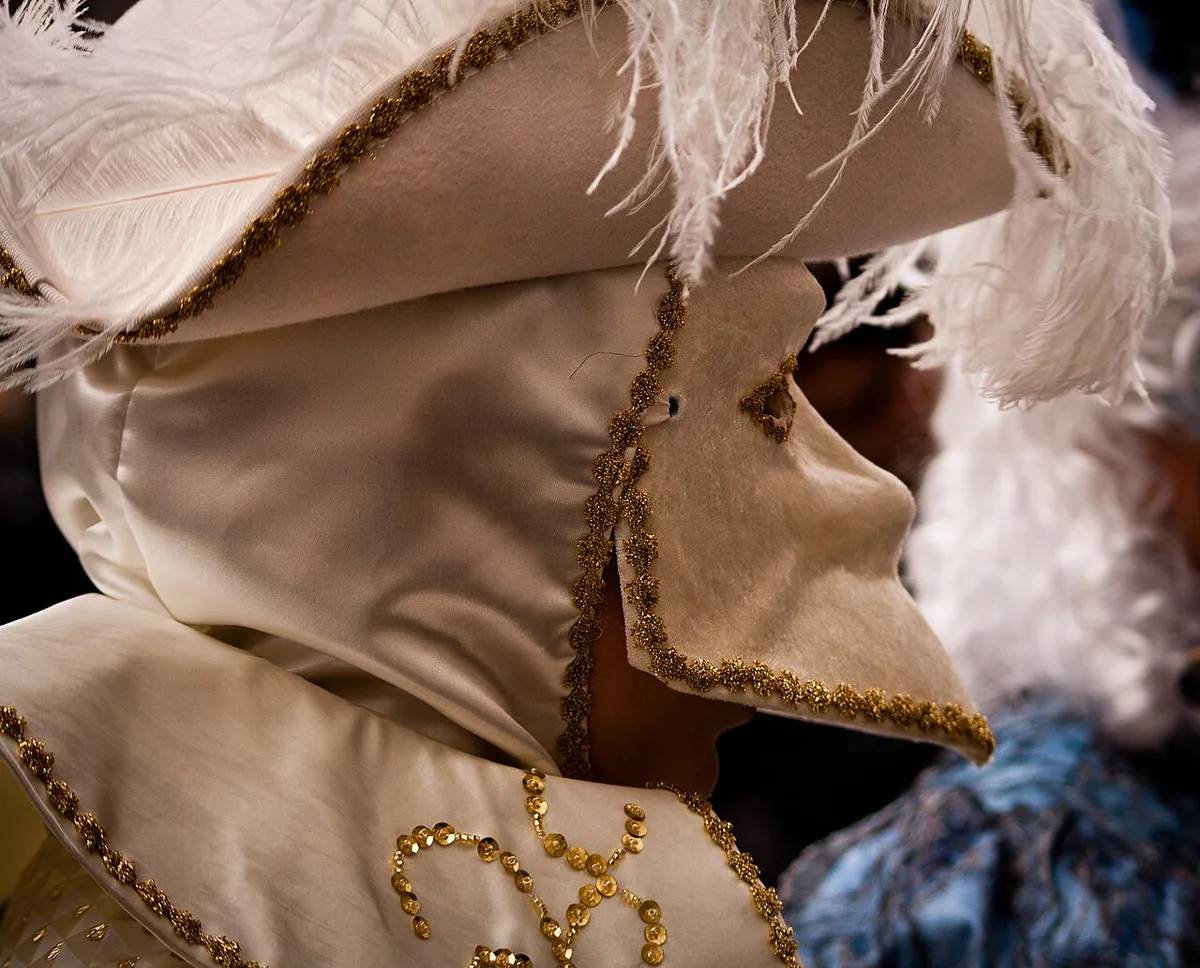
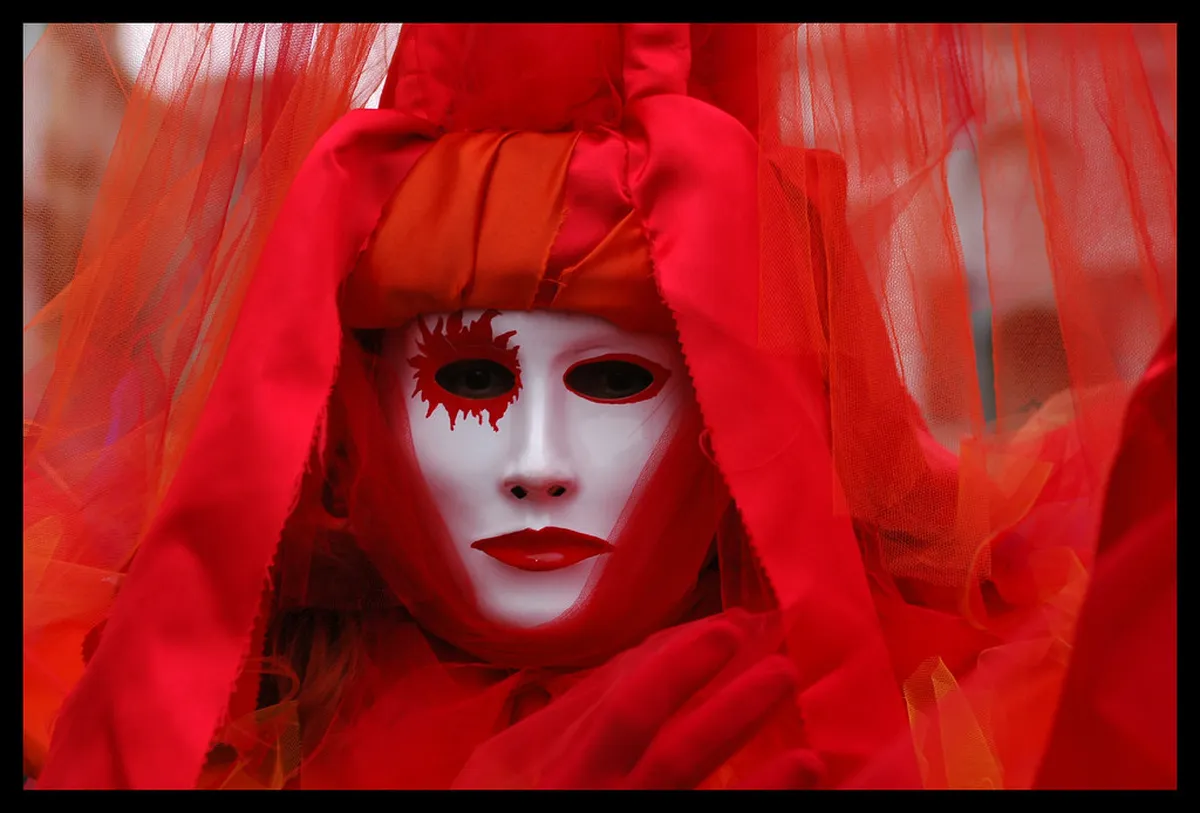
- Bauta: an angular white or black face mask with no mouth cutout, letting the wearer eat, drink, and talk while staying fully anonymous; historically paired with a black cape (tabarro) and tricorn hat.
- Medico della Peste (Plague Doctor): the long, beaked mask that plague doctors once wore to hold aromatic herbs believed to filter disease; today it is worn purely as costume, not medicine.
- Volto (Larva): the classic plain white full-face mask, thinner and closer-fitting than the Bauta, traditionally worn with a tricorn hat and cape for formal Carnival dress.
- Moretta (Servetta Muta): an oval black velvet mask for women, held in place by a button gripped between the teeth, which forces silence on the wearer.
- Colombina: a half-mask covering the eyes, nose, and cheekbones, popularized by the maidservant character in Commedia dell'Arte and often decorated with gold leaf, crystals, or feathers.
- Commedia dell'Arte character masks: leather or papier-mâché faces for stock characters such as Arlecchino (Harlequin), Pantalone, and Zanni, each tied to a fixed stage role.
Where to Buy Authentic Carnival Masks in Venice
San Polo and Dorsoduro remain the two districts where working ateliers still shape masks by hand, away from the souvenir stalls that ring St. Mark's Square. A genuine bottega artigiana starts from cartapesta, layers of paper pulp and glue pressed into a mold and left to dry before painting. Cheaper alternatives are molded from plastic or resin, then finished with a thin paint layer that chips faster than hand-applied gesso and gold leaf. Competition from cheaper imports has accelerated a decline in this historical Venetian craft. Treat a very low price on a full-face mask as a signal to check the material before buying. Pair a mask-shopping walk with the wider Venice travel guide for vaporetto routes linking San Polo, Dorsoduro, and St. Mark's Square.
- Material: cartapesta feels slightly rough and matte; plastic and resin feel smooth, uniform, and colder to the touch.
- Weight and flex: a paper-mâché mask is noticeably lighter and has a little give at the edges; rigid plastic barely flexes.
- Signature: authentic pieces usually carry the artisan's name, a workshop stamp, or a visible "Made in Venice" mark, rather than a generic printed label.
- Price tier: expect a rough scale from € for a simple painted souvenir mask, through €€ for a mid-range hand-finished piece, up to €€€ for a fully hand-painted collector mask with gold leaf or gems.
Budgeting for a Venetian Mask
Price mostly tracks material, decoration, and time spent by the artisan, not brand name or shop location. A simple painted papier-mâché mask sits at the low end of the scale, marked around €. A mid-range piece with more detailed painting or trim moves into the €€ band. A fully hand-painted collector mask, finished with gold leaf, gems, or feathers, sits at €€€ and takes an artisan considerably longer to finish than a souvenir piece. Workshops that let you paint your own blank mask are usually priced well below a ready-made collector piece, since the labor is yours rather than the artisan's.
A mask-painting workshop finishes one piece in 1 to 2 hours, but authentic collector masks demand significantly more artisan labor and time, which explains why the three-tier price scale varies so dramatically from € to €€€.
- Material and construction: cartapesta and hand-applied gesso cost more in labor than molded plastic.
- Decoration: gold leaf, hand-painted detail, feathers, and gems raise the price above a plain painted finish.
- Size and coverage: full-face styles such as the Volto or Bauta typically use more material and labor than a half-mask like the Colombina.
- Workshop vs ready-made: painting a blank mask yourself in a workshop usually costs less than buying an artisan's finished collector piece.
Mask-Making Workshops and Ateliers Worth Booking
Several San Polo and Dorsoduro ateliers open their workbenches to visitors, letting you watch a mascheraro apply gesso and paint by hand. Most mask-painting workshops run 1 to 2 hours, cover one blank mask, and suit families and first-time visitors. As of 2026, book a workshop slot before arriving in Venice, since availability tightens during the final weeks before Shrove Tuesday. Combine a workshop with event entry by checking the Carnival ticket options page for what currently bundles with mask-making sessions. Venice's Carnival also runs a "la maschera più bella" (most beautiful mask) contest in St. Mark's Square, judged by a panel of international costume and fashion designers. The public record of contest winners stretches back to at least 2007, a sign of how competitive the event has become. Spectators can watch the contest for free from the square, though participants typically need to register through official Carnival channels beforehand.
Venice revived the public Carnival in 1979, transforming a tradition dormant since the 19th century into thriving commercial activity; workshop demand now tightens availability during the final weeks before Shrove Tuesday.
When and Where to Wear Your Mask
Historically, Venetians could wear masks from Santo Stefano on 26 December through Shrove Tuesday, plus on Ascension and again from 5 October to Christmas. That left much of the year open to disguise, though sacred spaces such as churches were always off-limits. Modern Carnival compresses that calendar into a shorter window built around Shrove Tuesday, the movable date that ends the festival each year. Carnival is tied to the Christian calendar, so its exact dates shift annually. Treat any specific date as expected, computed from the Shrove Tuesday recurrence rule, until the organizer confirms it. Check the Venice Carnival guide for the next edition's organizer-confirmed dates once they are published. Skip the mask stalls directly outside train and airport terminals, since stock there skews toward plastic imports rather than cartapesta. St. Mark's Square vendor stalls carry a similar mix, so treat a shop's location, not just its window display, as a first filter.
How Venice's Masks Compare to Italy's Other Carnival Traditions
Venice is not Italy's only Carnival with its own visual signature. Carnevale di Viareggio, on the Tuscan coast, centers on giant papier-mâché parade floats rather than face masks. Carnevale di Ivrea, in Piedmont, revolves around a fruit-throwing "Battle of the Oranges" instead of mask craft. Both events share papier-mâché's role in Italian Carnival culture, even though Venice applies the material to faces rather than floats or crowd props. For a wider view of how these traditions differ, the Italian Carnival overview lays out each region's calendar side by side. Pairing a Venice mask-shopping trip with either event means checking Viareggio Carnival: The Complete Guide to Tuscany's Giant Float Parade or Carnival of Ivrea: Battle of the Oranges Travel Guide for their own dates before booking transport.
For trip-planning details, see Venice Carnival Masks official source and Venezia Unica city tourism.
Frequently Asked Questions
How much does an authentic Venetian Carnival mask cost?
Authentic masks follow a rough three-tier scale rather than one fixed price. Simple painted souvenir masks sit at the low end, marked with a single €. Mid-range hand-finished pieces cost more, marked around €€. Fully hand-painted collector masks with gold leaf or gems sit at the top, around €€€. Ask the artisan directly which tier a specific piece falls into before buying.
What is the difference between a Bauta and a Volto mask?
A Bauta has no mouth cutout, so you can eat, drink, and talk while staying anonymous. A Volto (Larva) is a thinner, close-fitting white mask usually worn for formal Carnival dress rather than eating or drinking.
How long does a mask-making workshop in Venice take?
Most atelier workshops run 1 to 2 hours and cover one blank mask, which suits families and first-time visitors. Book a slot before arriving, since spots fill up during the final weeks before Shrove Tuesday.
When can you wear a mask in Venice?
Historically, masks were allowed from Santo Stefano on 26 December through Shrove Tuesday, plus on Ascension and from 5 October to Christmas. Today, most visitors wear masks only during the official Carnival weeks. Check the Venice Carnival guide for the next edition's expected dates.
How can you tell a real Venetian mask from an imported one?
Check the material first. Cartapesta feels light and slightly matte. Plastic and resin feel smooth, uniform, and colder. Look for an artisan's signature, a workshop stamp, or a "Made in Venice" mark rather than a generic printed label.