

Last updated August 2026, this guide to Venice Carnival costumes covers rental costs, purchase prices, and traditional styles. It also explains how to wear a full costume around Venice's stone bridges and vaporetti. Renting a period costume for one night starts around €280, while a hand-finished Settecento gown can cost several thousand euros to own outright.
Traditional Venice Carnival Costume Styles and History
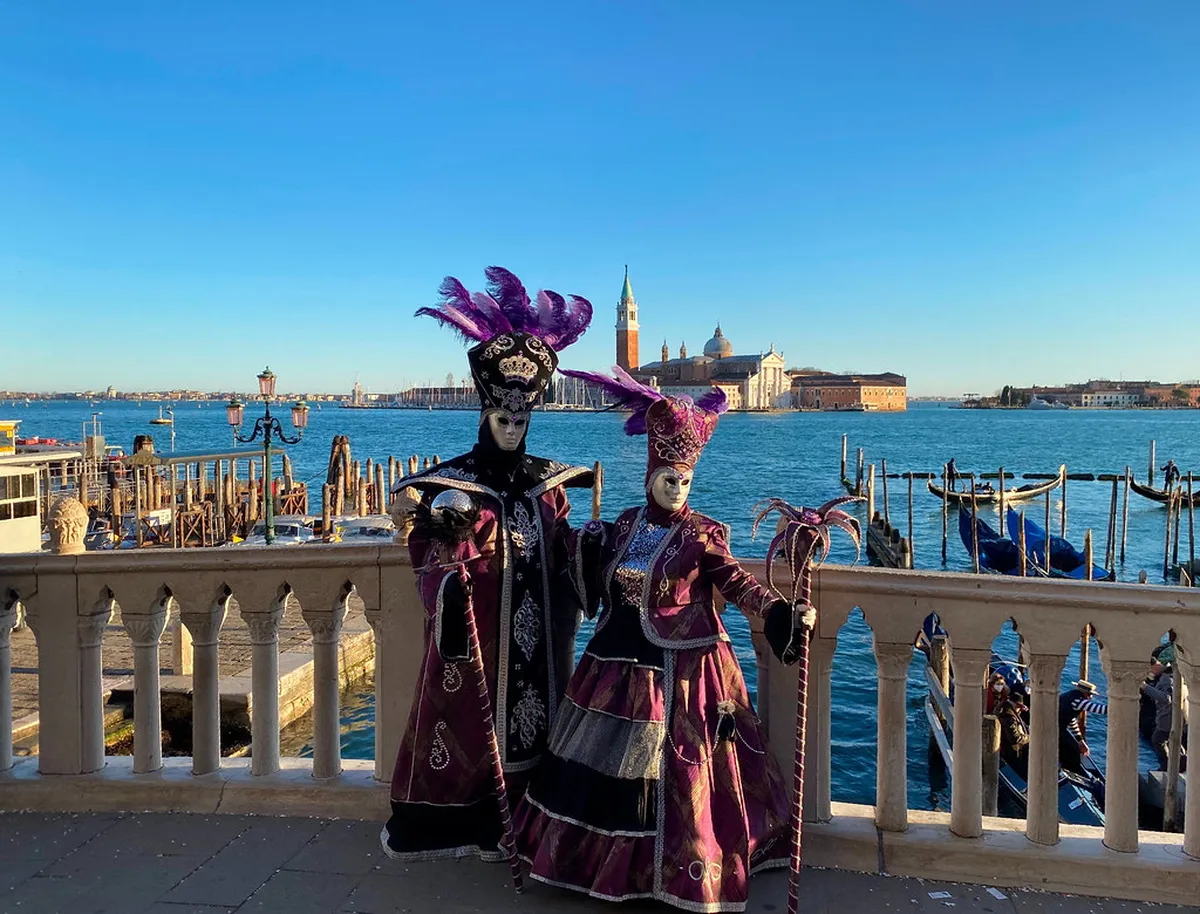
Commedia dell'Arte costumes reenact stock theatre characters instead of 18th-century nobility. Harlequin's diamond-patterned patchwork, Pantalone's long red robe, and the Zanni servant's plain tunic trace back to Venetian street theatre. Settecento costumes sit at the opposite end of the scale: silk, brocade, and lace styled after the era of Casanova and painter Giambattista Tiepolo. Venice-based ateliers describe this period as the height of Carnival extravagance, when the city's economic decline did little to restrain the wardrobes of its upper classes. Bauta is Venice's most traditional all-purpose disguise, pairing a white mask with a black tricorn hat and a cloak called a tabarro. Its beak-shaped chin line was built for a reason: wearers can eat, drink, and talk without removing the mask, unlike the fully sealed volto mask. Women traditionally paired a lace hood, the zendale, with a mask worn underneath; shops today sell the same piece as a zendal. Medico della Peste, the plague doctor, began as 17th-century protective gear rather than a Carnival costume. Modern ateliers now treat its long beaked mask and black coat as one of the more photographed disguises around St. Mark's Square. Venice Carnival appears among the seasonal events profiled by Italy's national tourism site, worth a look before booking anything.
| Costume Style | Historical Basis | Ease of Movement | Best For |
|---|---|---|---|
| Commedia dell'Arte (Harlequin, Pantalone, Zanni) | Venetian street theatre | Easy — fitted, lightweight pieces | First-time wearers, casual photos |
| 18th-century Settecento gown | Casanova-era Venice, silk and brocade | Difficult — full skirts and structured bodices | Grand balls, formal portraits |
| Bauta (mask, tricorn, tabarro cloak) | 18th-century civic disguise | Moderate — cloak layers over normal clothes | Walking the city, eating and drinking in disguise |
| Zendale (lace hood) | Traditional women's veil | Easy — worn over an existing outfit | Pairing with a volto or moretta mask |
| Medico della Peste (plague doctor) | 17th-century protective gear, later adapted for Carnival | Moderate — long coat and beaked mask | Dramatic photography, evening events |
Renting a Venice Carnival Costume: Cost and Process
Costume ateliers work more like made-to-order workshops than costume shops with racks of ready sizes. Pieces are handmade, so stock is limited; Venice-based rental services recommend booking a few months before Carnival. A typical process starts with browsing an online catalogue, then attending a fitting appointment at the atelier, commonly just a few minutes from the Rialto Bridge. Some services deliver the finished costume straight to a hotel, which suits guests heading to a ball the same evening. Ateliers stay open outside Carnival season too, so a summer visit to Venice is one way to get a fitting done and a made-to-measure piece ordered without competing for January appointment slots.
- 24-hour costume rental starts from around €280, per Venice-based rental listings.
- A shorter, lower-cost alternative: a roughly two-hour costume photoshoot rental starts from about €195, well below the price of a full 24-hour rental.
- A guided atelier tour that includes trying on pieces starts from around €150.
- Hotel delivery is available through some ateliers for guests attending a ball the same night.
Buying an Authentic Venice Carnival Costume: Where to Shop
Original Venice Shop, a Venice-based costume-and-accessory atelier, lists over 250 pieces across capes, tricorns, walking sticks, and complete dresses, with free shipping on orders over €150. Purchase prices span roughly €400 to several thousand euros depending on materials and detail. A complete Bauta costume there is priced at €590, and a handmade Renaissance-style lady's dress runs €420. Material quality is the clearest signal across capes, tricorns, and gowns: hand-finished trims, natural fabrics, and gold-leaf detailing on accessories take longer to produce and cost more than mass-produced synthetic pieces. Weight and stitching are worth checking in person or asking about directly; a hand-finished piece rarely feels perfectly uniform or unusually light.
- Classic tricorn hat: from €40
- Cape with lace trim: from €110
- Unisex wool cloak: from €360
- Walking stick with a carved lion or zodiac-sign head: from €150
- Complete Bauta costume, ready to ship: from €590
Attending the Grand Balls: The 2027 Season
Private masked balls run alongside the citywide Venice Carnival program, and most need a separate ticket from general Carnival attendance. Venice-based ball organizers currently list several dates for the 2027 season, drawn from tour-operator and ball-organizer schedules rather than the city's official festival calendar. Treat these as expected dates rather than fully confirmed until closer to the season, and recheck before booking a costume around any single night. For the citywide program and confirmed festival dates, see the Venice Carnival guide. Other Italian festival dates across the year are collected in the Italy festival calendar. These are currently listed starting prices from ball organizers, not the final word, so confirm the date and cost directly with the organizer before locking in a rental.
Ball tickets begin at €690, substantially exceeding the €280 for a 24-hour costume rental, so event costs and costume expenses require separate budgeting for attendees.
| Ball | Listed Date (2027 Season) | Starting Price |
|---|---|---|
| Venice Carnival Masked Ball | 23 January 2027 | From €690 |
| Doge's Ball | 6 February 2027 | From €800 |
| Tiepolo Ball | 6 February 2027 | From €850 |
| Carnival Extravaganza | February 2027 (exact date pending) | From €630 |
| Minuetto costume dinner and period dances | Within the 2027 season | From €780 |
Wearing a Costume in Venice: Practical Tips
A full Settecento skirt hides a comfort problem: cobblestones and dozens of stone bridge steps. Most wearers keep flat, closed-toe shoes under a long skirt instead of the polished heels the outfit suggests. February in Venice runs cold and damp, so thermal layers under a costume matter more than the costume fabric itself. That's a different climate from a Ferragosto travel season visit in mid-August, when the concern is heat rather than frost. Photographers cluster in a few reliable spots around St. Mark's Square, and a costume that trails on the ground gets stepped on fast in a crowd. Give a wide cloak room to swing before stepping into a packed vaporetto doorway.
A €195 two-hour photoshoot rental sidesteps the mobility challenges of full-length costumes on cobblestones and stone bridge steps, while photographers cluster predictably at St. Mark's Square.
Costume Mistakes to Avoid
A few recurring mistakes separate a smooth Carnival night from a stressful one. General trip-planning resources from the Italian National Tourism Agency are worth checking before a first Carnival visit from abroad.
- Buying a mass-produced costume with synthetic trim at a souvenir stall and expecting atelier-level detail; the two are made differently and priced differently for a reason.
- Waiting until the week of Carnival to book a rental; handmade pieces are limited, and ateliers fill fitting slots months ahead.
- Skipping a mobility test: try sitting, climbing stairs, and walking in a heavy skirt or stiff cloak before committing to it for a full evening of bridges and crowds.
- Forgetting to confirm delivery: ask whether the atelier delivers to a hotel or whether the costume needs collecting and returning in person.
How to Choose an Authentic Venetian Mask
A named Venice mask workshop is a better starting point than an unmarked souvenir stall. Traditional mascherari make and finish masks by hand, often using papier-mâché, then add paint, fabric, metal leaf, or applied decoration. The result need not look perfectly identical to another mask.
Look for workshops such as Ca’ Macana in Dorsoduro or Tragicomica in San Polo, near Calle dei Nomboli. Ask what the base material is and whether the decoration was applied in the workshop. A well-made mask should sit securely without pressing painfully on the nose or blocking peripheral vision.
- Papier-mâché: light, breathable, and traditionally associated with Venetian mask-making.
- Plastic: usually cheaper and uniform; useful as a souvenir, but not an artisanal costume piece.
- Wearability: choose ribbons or an elastic fitting that stays secure while walking over bridges or boarding a vaporetto.
Buying directly from a local workshop also gives visitors a clearer link to the craft behind Carnival, rather than treating the mask as a disposable accessory.
For related deep-dives, see our Italy in August: Heat, Ferragosto, and Where to Go and Italy in July: Heat, Crowds, and Where to Go guides.
Frequently Asked Questions
Is it worth renting a Venice Carnival costume, or buying one?
Renting suits a single ball night or photoshoot, since a 24-hour rental starts around €280 and needs no shipping or storage afterward. Buying makes more sense for repeat visits or a piece to keep permanently; a complete costume can run from around €400 into the thousands depending on materials and detail.
What is a Bauta, and why does it appear in so many Venice Carnival costumes?
Bauta pairs a white mask with a black tricorn hat and a cloak called a tabarro. Its beak-shaped chin line lets the wearer eat, drink, and talk without removing the mask, which made it Venice's standard, all-purpose disguise rather than a single-scene theatre costume.
Is there a lower-cost way to try a Venice Carnival costume without a full 24-hour rental?
Yes. A costume photoshoot rental, typically around two hours in St. Mark's Square or a gondola, starts from about €195. That's well under the roughly €280 starting price for a full 24-hour rental.
When are the Venice Carnival grand balls in the next season?
Venice-based ball organizers currently list several dates for the 2027 season. 23 January 2027 is the listed date for the Masked Ball, and 6 February covers both the Doge's Ball and the Tiepolo Ball. Carnival Extravaganza and the Minuetto dinner-and-dance event follow later in the season. These are organizer-published dates, not the city's official festival calendar, so confirm exact dates before booking a costume around them.
How do you spot an authentic Venetian costume instead of an imported one?
Check materials first: hand finishing, gold-leaf trim, and natural fabrics like silk and brocade take longer to produce and cost more than mass-produced synthetic pieces. Buying from a named Venice atelier, rather than an unmarked street stall, is the more reliable route to an authentic piece.
What should you wear under a Venice Carnival costume in February?
Plan for Venice's cold, damp winter weather rather than relying on the costume fabric to keep you warm. Thermal base layers under a long skirt or cloak work better than brocade or velvet alone, especially for evenings spent standing outside for photos.