Last updated July 2026: this guide covers the Viareggio Carnival end to end, from parade dates to Rioni street parties. Tuscany's version trades Venice's masked balls for satirical, papier-mâché floats that can rise 46 feet tall. Use it to weigh Viareggio against Venice or Ivrea's Battle of the Oranges before you book a February trip to Italy. It is also the reason not to look for a carnival in Florence: Viareggio is ninety minutes west and is Tuscany's carnival, as the Florence festival calendar explains. Its parades close on the same Shrove Tuesday as Venice's — the date rule gives that day for every year to 2036.
What Is the Viareggio Carnival?
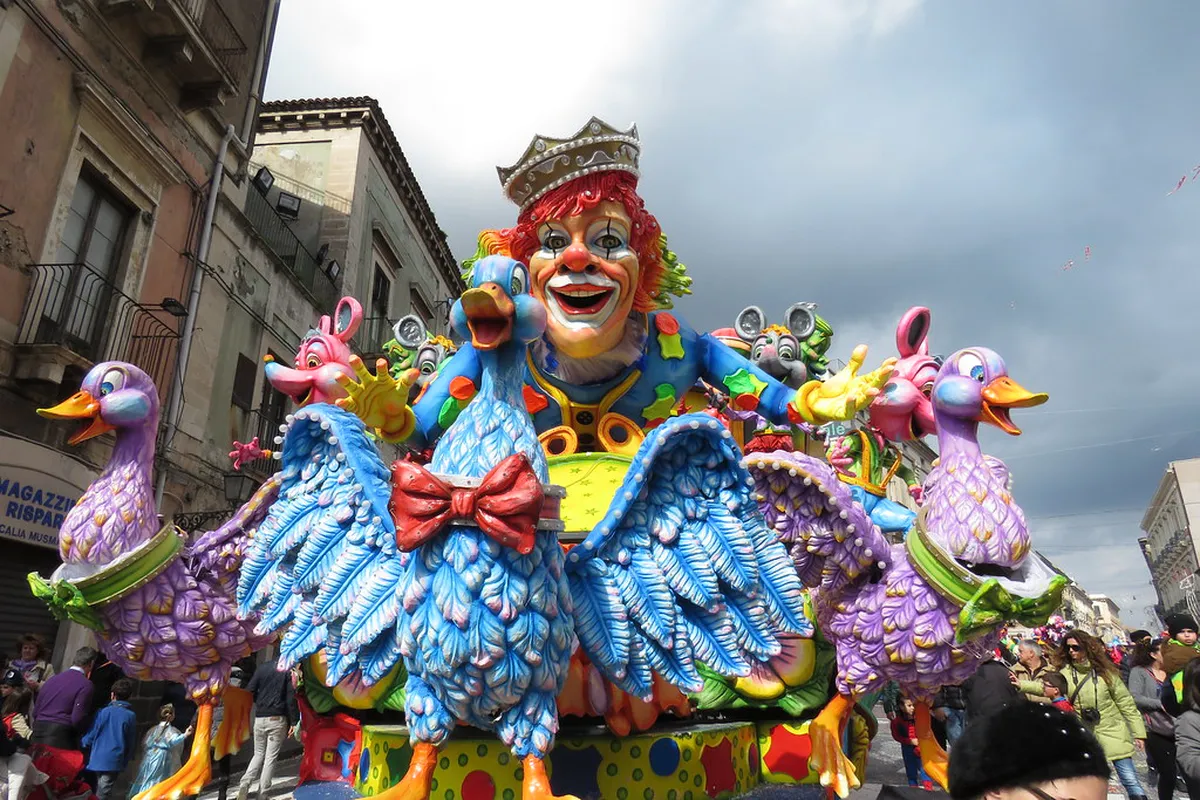
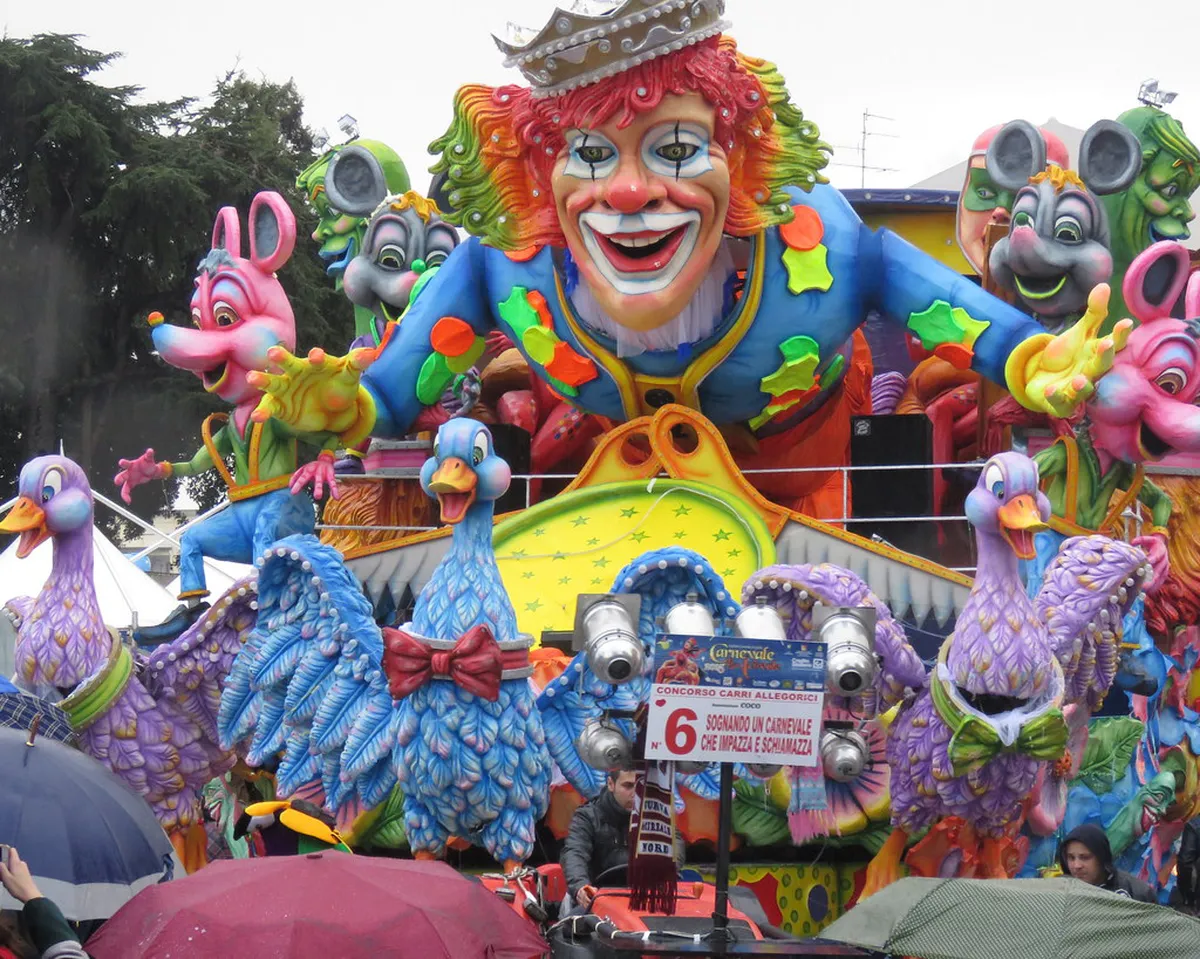
Viareggio Carnival (Carnevale di Viareggio) started on Mardi Gras in 1873. Wealthy residents organized a parade of flower-decorated carriages along the old Via Regia. Local citizens wore masks that day to protest rising taxes, and that streak of political satire has defined the event ever since. The first float to win a prize, in 1883, was I Quattro Mori, modeled on the Four Moors statue in Livorno. Builders introduced the papier-mâché technique in 1925, changing how the floats were built from that point on. War interrupted the Carnival twice: it paused during World War I and resumed in 1921, then paused again during World War II and resumed in 1946. Today's floats can weigh up to 40 tons and rise as high as 46 feet. Floats routinely caricature politicians and celebrities; a 2019 float satirizing world leaders drew international press coverage. Burlamacco, the clown-like mascot in a red-and-white harlequin suit, has represented the Carnival since illustrator Uberto Bonetti created the character in 1931. Between 500,000 and 600,000 spectators attend across the season, according to published event estimates, with a single-parade record of about 325,000 attendees in 2011. The Viareggio Carnival Foundation organizes the event today and maintains the Cittadella complex where the floats are built.
Viareggio Carnival vs. Venice and Ivrea: Choosing Your Italian Carnival
Choosing between Italy's carnivals comes down to atmosphere. 7 Best Things to Do at Venice Carnival: Free Events, Balls and Masks favors elaborate costumes, masked balls, and canal-side settings rooted in centuries of aristocratic tradition. Carnival of Ivrea: Battle of the Oranges Travel Guide takes a rowdier route, staging its Battle of the Oranges as a mock civil war between rival town teams. Viareggio sits between the two: outdoor, satirical, and built around scale rather than intimacy. Families often prefer Viareggio for its daytime parades and open-air energy, while travelers chasing unusual traditions lean toward Ivrea's food-fight spectacle. Ivrea and Viareggio both lean into crowd participation, but only Ivrea puts spectators inside the action; Viareggio keeps everyone along the barriers watching floats roll past. Both events run in winter, but Venice's masked balls happen mostly indoors while Viareggio's parades stay outdoors on the seafront rain or shine.
| Carnival | Style | Focus | Best For |
|---|---|---|---|
| Viareggio | Satirical, outdoor | Giant papier-mâché floats along the Passeggiata | Families and first-time visitors |
| Venice | Historic, indoor-leaning | Masked balls and canal-side costume displays | Travelers wanting elegance and photography |
| Ivrea | Combative, participatory | The Battle of the Oranges | Visitors wanting a hands-on tradition |
The Grand Masked Parades: Route, Floats, and Schedule
Six parades typically fill the Viareggio Carnival season, including Fat Thursday and Mardi Gras itself. Each parade follows the same 2-kilometer loop along the Passeggiata, Viareggio's Liberty-era seafront promenade. First-class floats lead the procession, followed by smaller second-class floats, masked groups, and individual mask performers. The 2026 season alone fielded nine first-class entries, according to the event's published program. Opening and closing nights both end in fireworks over the water, bookending the season. Night editions of the parade, such as the two staged during the 2026 season, add lighting effects that daytime parades skip.
Carnival dates shift every year because they're calculated relative to Easter, so Viareggio's calendar moves too. Expect the season to run roughly six weeks, built around four to five Sunday parades plus the key Fat Thursday and Mardi Gras dates, continuing a little past Ash Wednesday. Travel guides reported the 2027 calendar as set, running from Saturday, January 30 through Saturday, February 21. Treat these dates as expected rather than final, and confirm them on the official Carnival site closer to the season.
| Date | Parade |
|---|---|
| Saturday, January 30 | Opening parade and fireworks |
| Thursday, February 4 | 2nd parade (Fat Thursday) |
| Sunday, February 7 | 3rd parade |
| Tuesday, February 9 | 4th parade (Mardi Gras) |
| Sunday, February 15 | 5th parade |
| Saturday, February 21 | 6th closing parade, awards, and fireworks |
Inside the Rioni: Viareggio's Neighborhood Street Parties
Parades are the show, but the Rioni are the soul of Viareggio Carnival. These neighborhood parties take over the streets after dark, with music, dancing, and food trucks running long past midnight. Darsena hosts the best-known street party, typically running five consecutive nights from Friday to Tuesday during its peak week in mid-February. Marco Polo and Croce Verde Centro run their own multi-night parties earlier in the calendar, and Vecchia Viareggio (Old Viareggio) opens the season in late January. One district event even moves inland to Torre del Lago, held in the foyer of the Giacomo Puccini theatre. Local theater troupes also stage plays in Viareggio's vernacular dialect throughout the celebration, a tradition older than the float parades themselves. Street stalls sell chiacchiere (called cenci in Tuscany) and frittelle, the fried dough treats that define Italian Carnival food. Several Rioni also run afternoon parties for children, including recent-season events in Campo d'Aviazione, Bicchio, Terminetto e Migliarina, and Varignano, kept separate from the late-night adult celebrations.
| Main Parade | Rioni Street Parties | |
|---|---|---|
| Time of day | Afternoon, typically starting around 3:00 p.m. | After dark into early morning |
| Cost | Ticketed, about €16.50-€22.00 | Usually free to join |
| Atmosphere | Large-scale spectacle with floats | Local street food, music, and dancing |
| Best for | First-time visitors and families | Repeat visitors wanting local immersion |
- Darsena — the best-known street party, running several nights in mid-February
- Marco Polo — multi-night celebrations earlier in the calendar
- Croce Verde Centro — paired evenings with the historic Carnival district
- Vecchia Viareggio (Old Viareggio) — opens the season in late January
- CarnevalPuccini — an afternoon event at the Puccini theatre in Torre del Lago
Cittadella del Carnevale: The Year-Round Home of the Floats
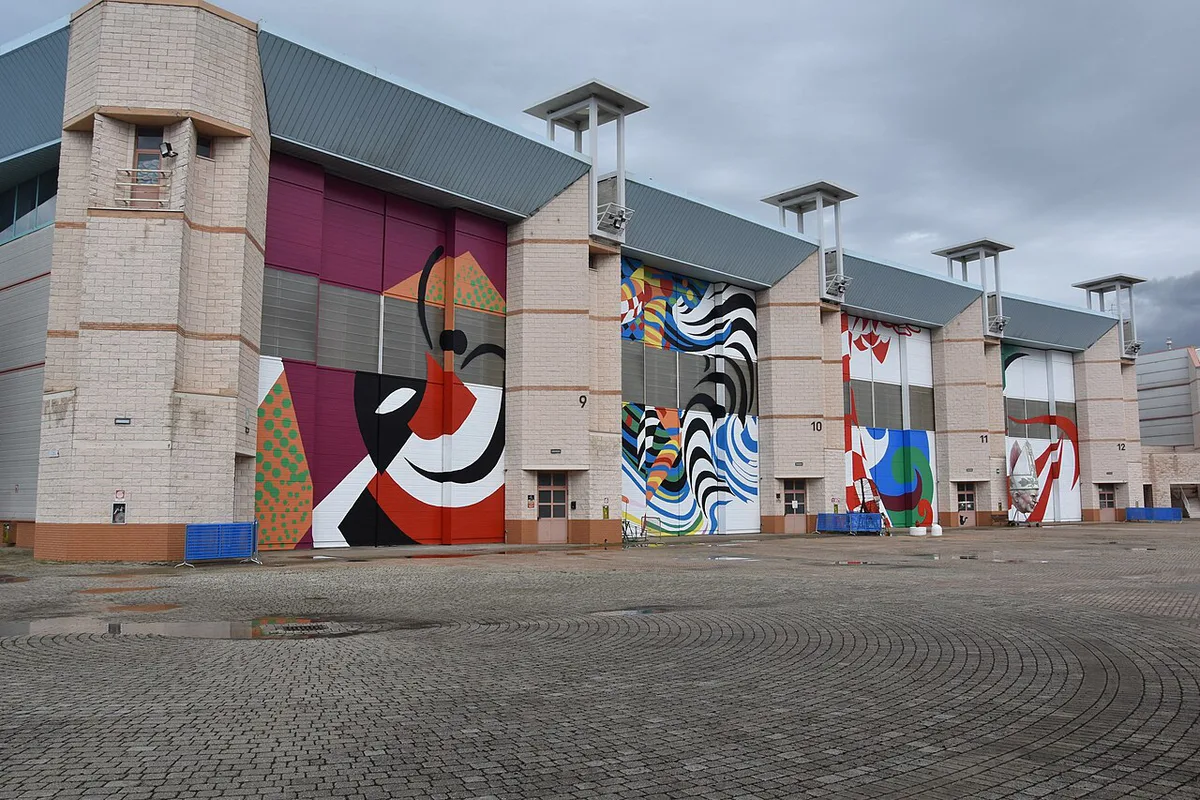
Cittadella del Carnevale opened on September 26, 2001, and now anchors the event year-round. Architect Francesco Tomassi designed the complex around a square dedicated to Burlamacco, ringed by sixteen hangars where builders construct the floats. Inside, the Carnival Museum traces more than 150 years of history through photographs, sketches, and posters, while a separate hall displays finished papier-mâché floats. A companion exhibition traces Carnival poster art from futurism through contemporary graphic design, using the hangar doors themselves as display screens. Educational workshops let children try working with papier-mâché alongside the float builders. Visiting outside parade season still gets you close to the craft, since workshops run through most of the year as builders prepare for the next Carnival. Cittadella's main entrance on Via Santa Maria Goretti also houses the primary ticket office for parade admission. Group bookings and schedule questions go through the ticket office at 0584 580740, or the dedicated group line at 0584 580741.
The papier-mâché float-building tradition that began in 1925 found its permanent home at Cittadella del Carnevale, which opened on September 26, 2001, to house the craft year-round.
- Monday-Thursday: 9:00 a.m.-1:30 p.m. and 3:00-6:00 p.m.
- Friday: 9:00 a.m.-5:00 p.m.
- Parade days: opens at 9:00 a.m.
Tickets, Getting There, and Where to Stay
Online tickets go through Vivaticket, while on-site sales happen at Piazza Mazzini and at the Cittadella box office. Buying online skips the entrance queue on busy parade days, though travelers without an Italian phone number have occasionally reported checkout problems. Ticket prices break down by age and height:
A 2011 parade attracted 325,000 spectators, demonstrating the crowd size; arriving early via train (a 10 to 15 minute walk from the station) helps secure good viewing spots on peak weekends.
During the busiest dates of the 2026 season, the ticket office extended hours to 9:00 a.m. until 6:00 p.m., so expect similar extended windows around peak weekends. These are the most recently published rates, so confirm current pricing on the official ticket site before you travel.
Direct trains reach Viareggio from Florence, Pisa, Lucca, La Spezia, and Cinque Terre. From the station, it's roughly a 10 to 15 minute walk to the Passeggiata and the parade route. Driving is harder: parking fills up fast during Carnival weekends, making the train the more reliable option.
Staying in Viareggio itself puts you within walking distance of the Rioni parties after the parades end. Lucca and Pisa carry more hotel inventory and often lower rates, with direct trains back to Viareggio on parade days. Bars, restaurants, and hotels across the wider Versilia coast also host their own masked nights during the season, extending the celebration beyond Viareggio itself. Book Rioni-adjacent Viareggio hotels well ahead of peak weekends, since rooms near the Passeggiata sell out first.
- Adults: about €22.00
- Children up to 14: about €16.50
- Children under 1.20 meters tall (about 3 feet 11 inches): free entry
Pro Tips: Sizing, Crowds, and Weather
Measure children at home before you queue: the free-entry cutoff is 1.20 meters tall, and gate staff verify height on busy days. The 2011 record crowd of about 325,000 for a single parade shows how packed the barriers can get, so arrive early on Fat Thursday and Mardi Gras. Claim a spot near the barriers well before a parade's start time, since prime viewing space fills in fast. Wind off the sea makes February evenings feel colder than inland Tuscany, so pack a windproof layer for night parades. Pair a Carnival weekend with a stop in Torre del Lago, home to the Giacomo Puccini theatre that hosts one of the Rioni's afternoon parties.
Walking from Viareggio Station to the Parade Route
Viareggio railway station is about a 10 to 15 minute walk from the Passeggiata, making the train practical on crowded parade days. Leave the station through the main exit onto Piazza Dante Alighieri. Continue west along Via Giuseppe Mazzini toward the sea and Piazza Mazzini.
Piazza Mazzini is a useful arrival point because it sits beside the seafront parade circuit and normally has ticket services nearby. Allow extra time when approaching the promenade. Security checks, temporary barriers, and dense pedestrian traffic can slow the final part of the walk.
The central route is mostly level, but families and travelers with limited mobility should avoid rushing from a train scheduled close to parade time. Check the return timetable before entering the circuit, especially for evening parades or Rioni parties. Late-night regional services may be less frequent than daytime trains.
Drivers should expect road restrictions and scarce parking near the seafront. Travelers staying in Pisa or Lucca can usually avoid those problems by using direct regional trains and walking from the station.
For trip-planning details, see Carnevale di Viareggio official source and Comune di Viareggio.
Continue planning with Palio di Siena: 8 Things to Know Before You Go.
Frequently Asked Questions
When is the next Viareggio Carnival?
Viareggio's next edition is expected to run from late January through late February 2027, based on the calendar reported ahead of the season. Confirm exact parade dates on the official Carnival website before booking travel.
How much are Viareggio Carnival tickets?
Adult tickets run about €22.00. Tickets for children up to 14 run about €16.50, and children under 1.20 meters tall enter free. These are the most recently published rates, so check the official ticket site for the current season before you buy.
Is Viareggio Carnival better than Venice Carnival?
Neither is objectively better; they're different formats. Viareggio focuses on outdoor satire and giant floats, while Venice centers on indoor masked elegance. Families and first-time visitors often prefer Viareggio's daytime parades and street food, while travelers chasing atmosphere and photography often prefer Venice.
How do you get from Pisa or Lucca to Viareggio for Carnival?
Direct trains connect Pisa and Lucca to Viareggio, and the station sits about a 10 to 15 minute walk from the Passeggiata. Driving is possible, but parking is scarce during parade weekends, making the train the more practical choice.
Can you visit the Cittadella del Carnevale outside of Carnival season?
Yes, Cittadella del Carnevale operates as a year-round museum and workshop complex. Visiting outside parade weekends still gets you close to the float-building process, plus the Carnival Museum's photo and poster archive.