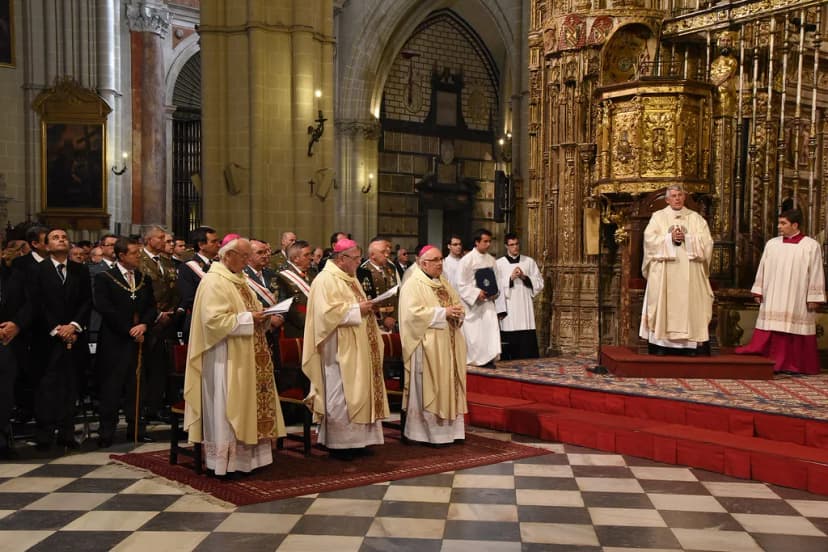
Three times a year, a sealed ampoule venerated as San Gennaro's dried blood is carried into Naples Cathedral, and the city waits to see whether it turns liquid. A slow or failed liquefaction is read as a warning for Naples, not treated as a curiosity. The ceremony is free, unticketed, and most visitors have no idea it's happening.
The Three Dates
The prodigy is attempted three times each year, and each date commemorates something different. Two are fixed calendar dates and one is rule-based, so all three can be planned around without waiting on an announcement.
| Date | Commemorates | Character |
|---|---|---|
| First Saturday of May | The translation of the saint's remains from Pozzuoli to the Capodimonte catacombs | Procession-led; the relics are carried through the city |
| 19 September | The saint's martyrdom, traditionally dated to 305 AD | The principal feast — the biggest crowd of the three |
| 16 December | The anniversary of the 1631 eruption of Vesuvius | The most local of the three; smallest visitor presence |
Reports of the liquefaction stretch back centuries: the earliest confirmed record dates to 1389, and over the following two and a half centuries the event grew from an occasional occurrence into the fixed three-times-a-year rhythm kept today. That long repetition is why the dates are fixed rather than announced — each has built up its own crowd and its own character over roughly six hundred years.
19 September is the one to target if you are choosing. It is the patronal feast proper, the cathedral is fullest, and the surrounding streets carry the most activity — and it falls inside the Festa di Piedigrotta programme, which runs from early September into October around Mergellina. December offers the opposite trade: the smallest crowd of the three and a shorter wait for a seat, worth choosing deliberately if watching the ritual itself matters more to you than the scale of the occasion. May sits between the two, built around the procession that carries the relics through the city rather than around the liquefaction alone.
Who Was San Gennaro?
San Gennaro — Januarius in English — is traditionally said to have come from Benevento, east of Naples, and to have risen to bishop while still a young man. He was arrested during the Emperor Diocletian's persecution of Christians in the early 4th century, after visiting a fellow Christian, Sossius, who was being held in prison near Pozzuoli, and the two were beheaded together rather than recant their faith. Naples has more than fifty officially recognised patron saints, but Gennaro is the principal one.
The blood itself has its own legend, separate from the martyrdom. A woman named Eusebia is said to have collected some of the martyr's blood at the site of his execution and kept it sealed in two small ampoules. When his remains were later moved to the catacombs beneath Naples, the dried blood is said to have liquefied on contact with his skull — the origin point for the ceremony still repeated in the cathedral. The relics travelled between Naples and Benevento more than once in the centuries that followed before settling permanently in the Duomo.
What Happens in the Duomo
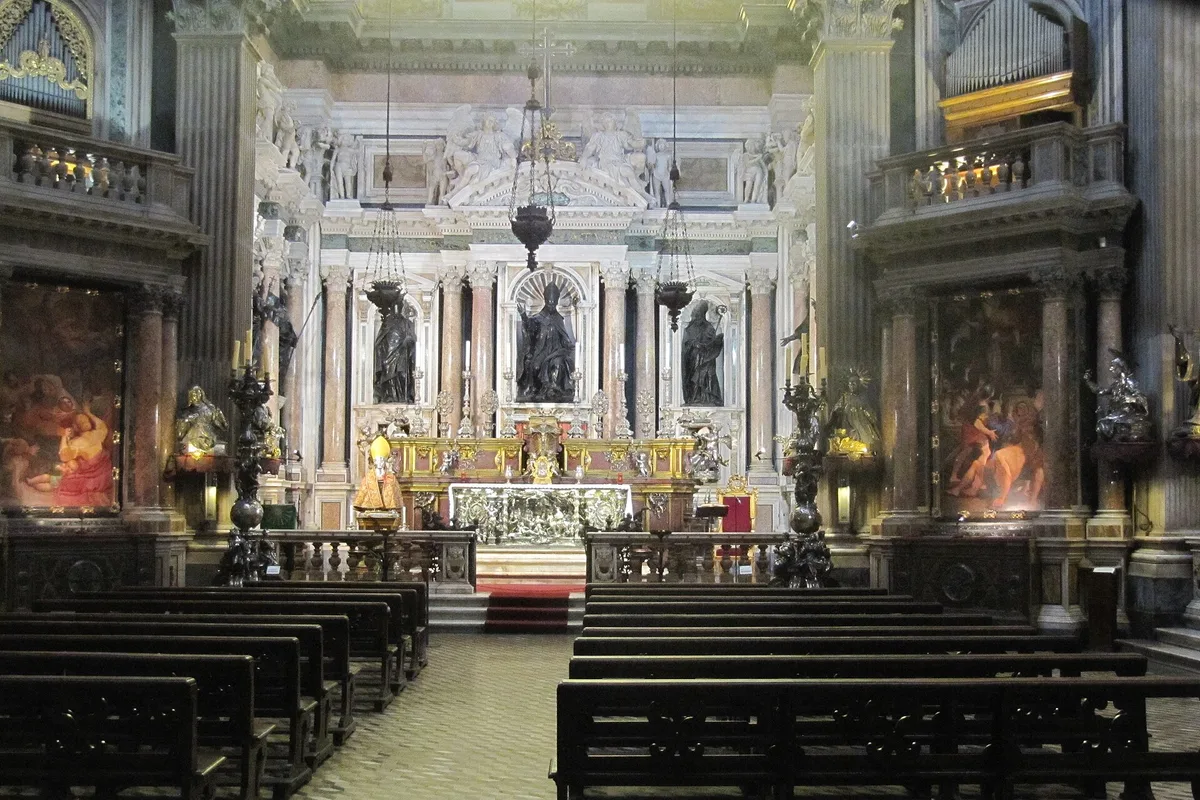
The ceremony follows the same shape each time. The reliquary containing the two sealed ampoules is brought from the Cappella del Tesoro to the high altar, and Mass is celebrated in the presence of the Archbishop of Naples, city authorities and the congregation. After Mass, the archbishop takes the reliquary and turns it, watching for the contents to move.
The waiting is the event. It can resolve in minutes or take well over an hour, and the cathedral holds its attention throughout. When liquefaction is observed, it is announced from the altar and a white handkerchief is waved — the signal that used to carry the news to the piazza outside before microphones. Recent September ceremonies have resolved around 10:00, though the timing varies and is not something to build a schedule around.
The two ampoules sit in a silver reliquary between round glass plates and spend the rest of the year in a bank vault, brought out only for the ceremony and the days that follow it. The congregation is not a passive audience: women from old Neapolitan families, known as the parenti di San Gennaro, traditionally lead the prayers and exhortations from the front pews, and the crowd around them calls out for the saint to hurry — "Fai presto, San Gennaro!" — until the archbishop confirms the change has happened.
A slow liquefaction, or a failure, is read locally as a bad omen for the city. This is not a piece of colour for visitors — it is taken seriously enough that failures make national news. Behave accordingly: this is a congregation waiting on something that matters to them, not a performance.
When the Miracle Doesn't Happen
Liquefaction is never guaranteed, and its absence is not treated lightly. A slow or failed liquefaction is read locally as a bad omen for the city, and history is part of why: Neapolitans point to specific years when the blood stayed solid and set them against events the city remembers as genuinely hard — the war years of the early 1940s, and more recently 1980, the year of the devastating Irpinia earthquake, and 2020, the year the Covid-19 pandemic reached Naples.
None of this is offered as proof of cause and effect, and the Catholic Church itself has never issued an official statement on the phenomenon despite supporting the celebrations for centuries. What matters for a visitor is the tone in the cathedral: this is not a stunt staged for tourists, and a failed or delayed liquefaction is reported as serious news in Naples, not folklore. Anyone attending should read the room accordingly — this is a congregation hoping for a specific outcome, not spectators at a show.
How to Attend
There is no ticket and no reservation. The cathedral is open to the public for the Mass and the ceremony that follows, and access is decided by arrival time and by whatever crowd management the cathedral applies on the day. On 19 September the Duomo fills early, so arriving well before the scheduled Mass is the only reliable approach.
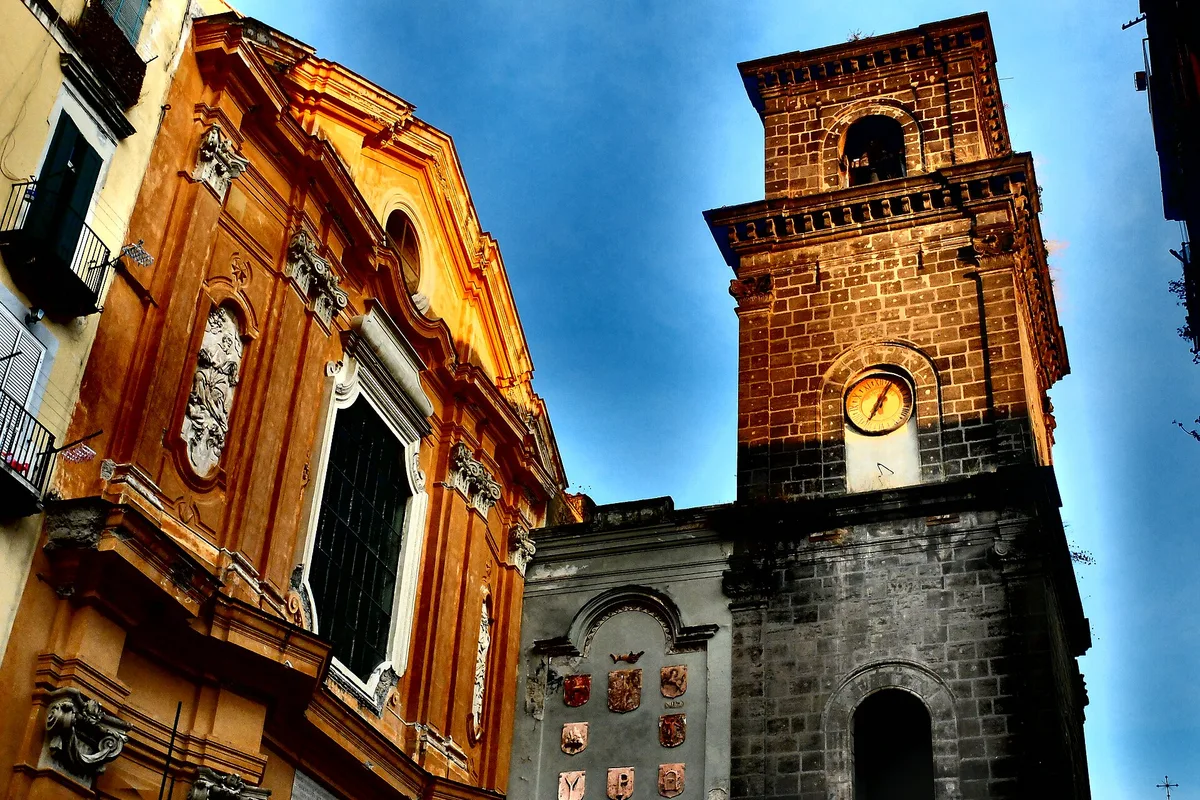
The same approach applies on the other two dates — arrive well before Mass — though the crowd for the first Saturday of May and for 16 December is smaller, so the margin you need is shorter. Naples Cathedral sits on Via Duomo in the historic centre, a short walk from Piazza Cavour on Metro Line 1 and from the Duomo stop on Line 2. The surrounding streets of the centro storico — Via dei Tribunali and Spaccanapoli in particular — carry the feast's street life, and are worth walking either side of the ceremony.
- Free — no ticket, no booking
- Arrive substantially before the Mass on 19 September; the cathedral fills
- Dress as you would for any working church: shoulders and knees covered
- The ceremony's length is unpredictable — allow the whole morning
- The Cappella del Tesoro and its museum hold the reliquary and the associated treasure the rest of the year
Is It Worth Planning Around?
It depends what you want from a festival. There is no parade to photograph, no fireworks, no spectacle in the ordinary sense — it is a religious ceremony in a cathedral, and the drama is entirely in the waiting. If you want visual spectacle, Naples delivers that better in December through the presepe workshops of San Gregorio Armeno, and Italy delivers it better still at Venice Carnival or the Palio.
What San Gennaro offers instead is access to something genuinely unperformed. Naples is a heavily visited city whose festival calendar is mostly civic programming; this is the one date where the city does something on its own terms, in front of whoever happens to be there. For a traveller who values that over spectacle, 19 September is the best day of the Neapolitan year. The Naples festival calendar covers the alternatives.
If you can only attend one of the three, weigh what you actually want from the day: 19 September for the fullest sense of occasion and the biggest crowd, 16 December for a quieter, more local version of the same ritual, and the first Saturday of May if the procession — the relics carried through the streets — matters to you as much as the liquefaction itself. The saint's May liquefaction falls near Holy Week in Naples and Campania, the city's densest religious week of the year.
Frequently Asked Questions
When is the Festa di San Gennaro in Naples?
Three times a year: 19 September, the saint's martyrdom and the principal feast; the first Saturday of May, marking the translation of his remains; and 16 December, the anniversary of the 1631 eruption of Vesuvius. 19 September draws the largest crowd.
What is the miracle of San Gennaro?
Two sealed ampoules held in Naples Cathedral contain what is venerated as the saint's dried blood. Three times a year the archbishop presents and turns the reliquary, and the congregation waits to see whether the contents liquefy. Liquefaction is taken as a good omen for the city; a delay or failure as a warning.
Do you need tickets to see the San Gennaro ceremony?
No. The Mass and the ceremony that follows are open to the public in Naples Cathedral with no ticket or booking. Access depends on arrival time — the Duomo fills early on 19 September, so arrive well before the scheduled Mass.
How long does the ceremony take?
Unpredictably long. After Mass the archbishop presents the reliquary and the wait begins; it can resolve in minutes or take more than an hour. Recent September ceremonies have resolved around 10:00, but the timing varies and should not be treated as a schedule.
Is the Festa di San Gennaro a spectacle for visitors?
No — it is a religious ceremony, with no parade or fireworks, and the drama lies in the waiting. It is worth attending precisely because it is unperformed, but travellers wanting visual spectacle will find more in Naples at Christmas around San Gregorio Armeno's presepe workshops.