
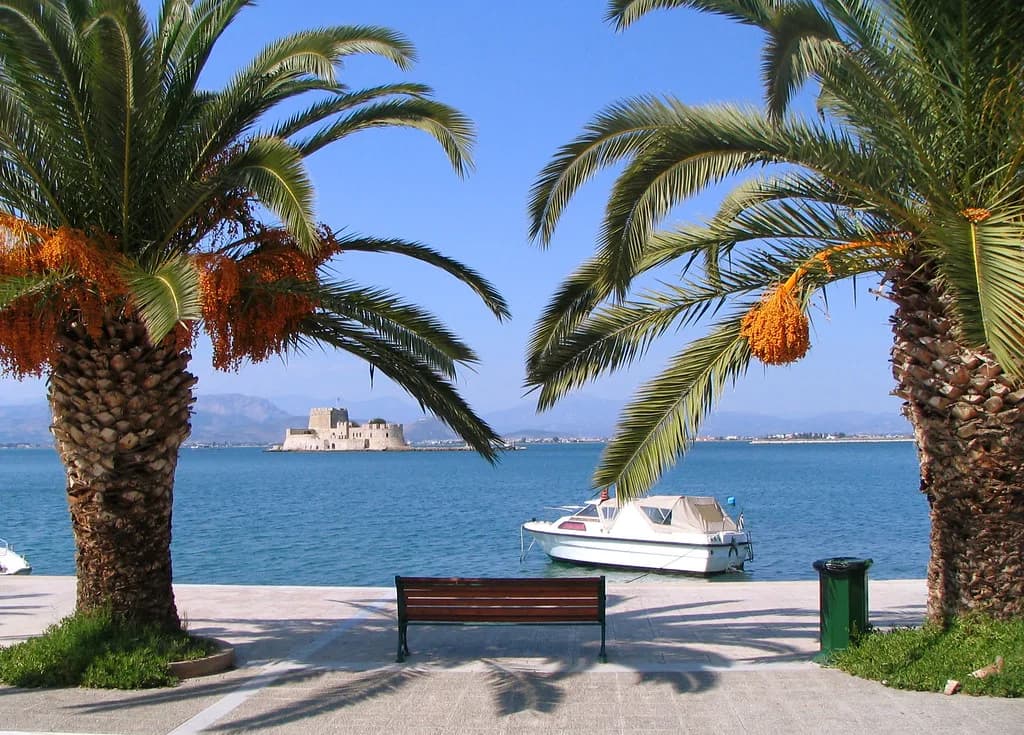
For Greeks, Easter is the most significant celebration of the year, a time when faith, family, and community come together. Nafplio, a historic seafront town in the Peloponnese, offers a particularly atmospheric setting for observing these traditions. During Holy Week, its old town becomes a stage for processions, candlelight, and solemn music, drawing visitors who want to experience an authentic Greek Orthodox Easter.
Visitors often come to Nafplio during this period because of its beauty and the vibrancy of its Easter celebrations. While the essence of Greek Easter is shared nationwide, Nafplio adds its own character, such as the musical accompaniment of the processions by the Municipal Philharmonic Band. This guide explains what happens each day, what to expect, and how to plan your trip without relying on fixed dates or prices.
Overview of Greek Orthodox Easter Timeline
Greek Orthodox Easter follows a different calendar than Western Christianity, so its date usually falls one to five weeks later. The celebration begins with Clean Monday, which marks the start of the 40-day fasting period, and culminates in Easter Sunday. During Lent, many Greeks abstain from meat, dairy, and other animal products, though the intensity of fasting varies by individual.
The final week, known as Holy Week, is the most intensely observed. It begins on Palm Sunday and includes daily church services, each commemorating a specific event from the last days of Jesus's life. The services attract locals and visitors alike, creating a solemn yet captivating atmosphere. To understand the full context, check the current year's Orthodox Easter date, as it is not fixed.
Holy Week in Nafplio: Daily Services and Atmosphere
During Holy Week, Nafplio's old town takes on a special aura. Churches such as Agios Spyridon and Panagia hold daily services, filling the air with the scent of incense and the glow of candlelight. For those unfamiliar with Orthodox liturgy, attending an evening service offers a glimpse into the devotion that defines this period. The congregation often stands throughout, and while you can sit, you will find many standing in contemplation.
These services are open to all, and visitors are welcome to observe respectfully. The atmosphere is reverent, and you may notice people greeting each other with 'Kalo Pascha' (Happy Easter) during this week. Even if you are not religious, the experience of being in the old town during this week is culturally enriching. For a practical overview of visiting Greece's festivals, you can consult our broader resource on festivals in Greece.
Good Friday: The Epitaphios Procession Through the Streets
Good Friday is the most solemn day of Holy Week. In the evening, each church takes its epitaphios—a symbolic representation of Christ's tomb—decorated with flowers, through the streets. Thousands of candles illuminate the town as the faithful follow the procession, singing hymns. In Nafplio, the scene is enriched by the participation of the Municipal Philharmonic Band, whose music adds to the emotional weight of the occasion.
A particularly moving moment occurs when the processions from different churches converge at Syntagma Square, the town's central square. Seeing the different epitaphios and their crowds meet is a powerful visual of community unity. The Omilo Greek language school, which has celebrated Easter in Nafplio for over two decades, notes that this convergence is a highlight of the evening. After the procession, the epitaphios is returned to its church.
Holy Saturday: Midnight Resurrection Service
On Holy Saturday evening, the atmosphere is one of anticipation. By 11 pm, most of the town gathers in churches, each holding an unlit white candle. At midnight, the lights dim, and the priest announces 'Christos Anesti' (Christ is Risen). The flame is passed from candle to candle, gradually illuminating the entire congregation. Then, church bells ring out, fireworks explode, and the celebration spills onto the streets.
After the service, families and friends return home or to tavernas to break the fast with magiritsa soup—a traditional dish made with lamb offal, herbs, and rice. Red eggs, dyed on Holy Thursday, are also cracked in a game where the person with the uncracked egg is said to have good luck. The greeting 'Christos Anesti' is exchanged, with the response 'Alithos Anesti' (Truly He is Risen). The feast continues into the early hours.
Easter Sunday: A Day of Feasting and Local Customs
Easter Sunday is a day of joy and celebration. From early morning, the smell of roasting lamb fills the air as families and tavernas prepare the festive meal. Kokoretsi—a dish of seasoned lamb innards grilled on a spit—is another specialty you may encounter. Many restaurants offer special Easter menus, but it's wise to book ahead if you plan to dine out, as the town fills with visitors.
The afternoon is marked by music, dancing, and long, leisurely meals. For travelers, this is an opportunity to join the locals in their celebration. You might be invited to crack a red egg or taste the tsoureki, a sweet Easter bread. If you are looking for other events in Nafplio, consider checking the Nafplio festivals calendar for upcoming celebrations throughout the year.
Easter Foods You'll Encounter in Nafplio
Easter in Greece is a culinary experience. The foods you will most likely encounter include magiritsa soup, red-dyed eggs, tsoureki bread, and roast lamb or goat. On Holy Saturday, tavernas serve magiritsa after the Resurrection service, and the red eggs are used for the cracking game. Tsoureki, a sweet bread flavored with mastic and orange, appears on tables throughout the season.
On Easter Sunday, the centerpiece is the roasted lamb, often cooked on a spit outdoors. This is accompanied by salads, mezedes (appetizers), and plenty of wine. Kokoretsi, though an acquired taste for some, is a beloved traditional food. Vegetarians may find the focus on meat challenging, but Greek cuisine offers plenty of vegetable dishes, so you won't go hungry.
Travel Tips for Visiting Nafplio During Easter
If you plan to visit Nafplio during Easter, know that this is a popular time for Greek tourists, especially Athenians, so accommodation fills up quickly. It's wise to book well in advance. While most events are free and open to the public, restaurants and tavernas may have limited seating, so reservations are recommended for Easter Sunday lunch.
Transportation to Nafplio from Athens is straightforward, with buses and cars being common options. During Holy Week, the town's streets can be crowded, especially for the main processions, so allow extra time to move around. For comprehensive guidance on attending festivals across the country, see our guide to festivals in Greece, which includes useful tips for visitors.
Plan Your Visit
Easter in Nafplio is a unique opportunity to witness Greek Orthodox traditions in a historic and welcoming town. From the candlelit processions of Good Friday to the joyous feasting of Easter Sunday, the experience is both moving and memorable. To make the most of your trip, plan your accommodation well in advance and be ready for large crowds during the key services.
For the most current information, including exact event schedules and any changes to traditions, consult the official tourism website of Nafplio or the Greek National Tourism Organization. While the basics of the celebrations remain constant year after year, details such as the meeting point of the processions or the time of the midnight service may vary. With a little preparation, you can enjoy an authentic Greek Easter in Nafplio.
Related festival guides
Frequently Asked Questions
What are some Easter traditions in Greece?
Greek Easter traditions include the 40-day fasting period leading up to Holy Week, the decoration of the epitaphios on Good Friday, and the midnight Resurrection service on Holy Saturday when 'Christos Anesti' is proclaimed. Families gather to crack red eggs and enjoy a feast with magiritsa soup and roasted lamb.
Why is Catholic and Greek Orthodox Easter different?
The difference stems from the calendars used. Catholic Easter follows the Gregorian calendar, while Greek Orthodox Easter follows the Julian calendar. The dates are calculated based on the first full moon after the vernal equinox, but the two calendars have different methods, so the holidays do not always coincide.
What not to miss in Nafplio?
In Nafplio, don't miss the Good Friday epitaphios procession, especially when multiple processions meet at Syntagma Square, accompanied by the Municipal Philharmonic Band. Also attend the midnight Resurrection service on Holy Saturday for a memorable experience.


