

Last updated August 2026, this guide covers the regata storica, Venice's largest annual rowing event, held on the Grand Canal every first Sunday of September. A costumed sixteenth-century procession opens the afternoon before six competitive races decide the season's real champions. Where you watch from changes the day more than the schedule does, from paid seating at the finish to a free spot on a canalside fondamenta. It is the competitive end of Venice's rowing calendar, which opens with the Festa della Sensa on Ascension Sunday: the Vogalonga in spring is a non-competitive mass row, and the Redentore in July is a night of boats and fireworks rather than a race. All three sit in the wider Venice festival calendar.
What Is the Regata Storica?
Regata storica is the single most important date on Venice's rowing calendar, pairing two very different experiences into one afternoon. A costumed procession of sixteenth-century-style boats opens proceedings, followed by a run of genuinely competitive races down the Grand Canal. Local crews treat the day as a season final: only the fastest boats from each category's earlier qualifying heats get a start here. Visitors often expect pure spectacle, but the racing carries real stakes for Venetian rowers. Race day runs on a fixed recurrence rule: the first Sunday of September, every year. Unlike some Venice events built around paid experiences, the best part of the regata storica costs nothing. Standing room along the Grand Canal's public banks and bridges is free, and only reserved finish-line seating charges admission. That mix of free public access and a genuinely competitive final sets it apart from a purely tourist pageant.
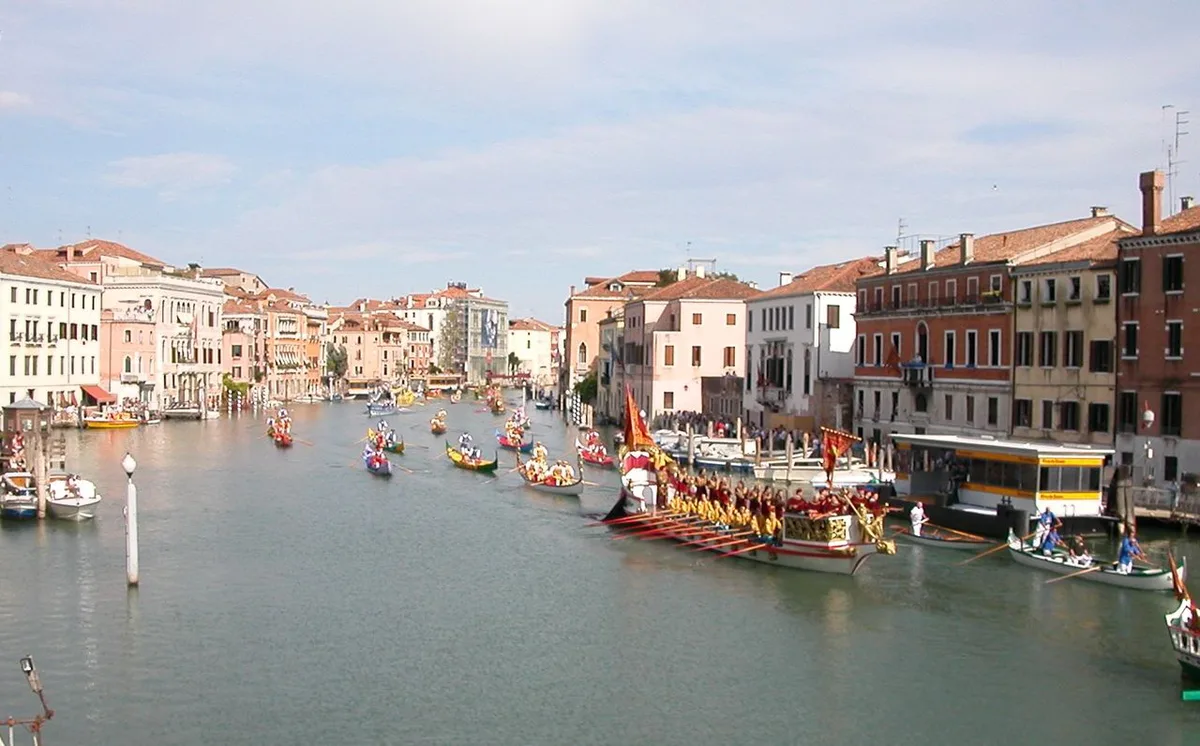
The Next Regata Storica: Dates and Schedule
September's first Sunday has been the fixed rule since the modern annual event took shape in 1841, and it has not changed since. The most recent edition ran on Sunday, September 7, 2025. Confirmed by the organiser's official site, the next regata storica is scheduled for Sunday, September 6, 2026. That date is already set well ahead of race day, since it follows the fixed recurrence rule rather than shifting year to year. Recent editions followed this running order, drawn from the published programme. Treat the minute-by-minute timing as expected rather than fixed: the organiser finalizes each year's schedule closer to race day, so confirm exact times on the official site before you plan around them.
- 3:30 pm - Corteo storico: the historical procession, with the Doge's parade fleet, departs St Mark's Basin.
- 4:00 pm - Junior heats on mascarete: the Maciarele and Schie categories.
- 4:30-4:50 pm - Young rowers' heats on pupparini: the Giovannissime and Giovannissimi categories.
- 5:10 pm - The six-oared caorline race.
- 5:40 pm - The women's mascarete race, two rowers per boat.
- 6:10 pm - Gondolini: the elite men's final, two rowers per boat.
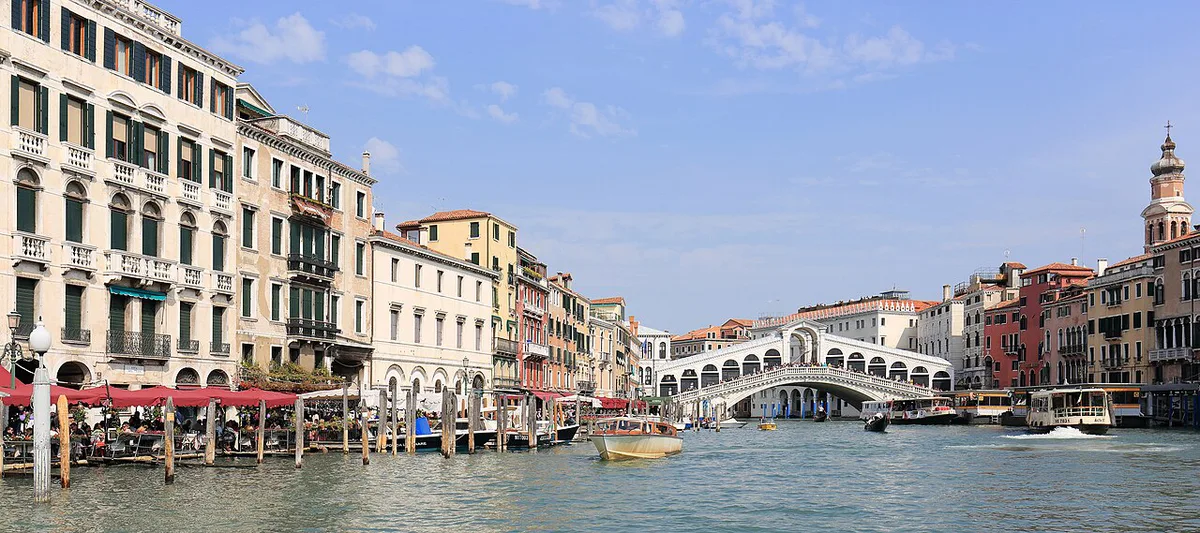
Where to Watch: The Spectator's Handbook
Where you stand shapes the day more than anything else about the regata storica. Each vantage point trades cost, comfort, and sightline in a different way. Ca' Foscari's Machina sits at the finish, and it's the only spot with a clear view of the actual result and the prize-giving. Tickets are sold through the event's official ticketing partner and go on sale weeks in advance. Expect this seating to cost noticeably more than every free option here, so book early if the finish matters more to you than the procession. Rialto Bridge delivers the most recognizable photo of the day, but arrive at least three hours before the 3:30 pm start for a rail-side spot. Crowds fill in fast, and there's no late option once the bridge is full. Punta della Dogana works best for the opening procession, since boats pass there first leaving St Mark's Basin. Accademia Bridge trades proximity for a longer, elevated sightline down the canal. Choose it if one wide photo matters more than closeness to the boats. Private palazzo balconies, booked through hospitality agencies or hotels with canal frontage, add comfort and a fixed private view, though availability is limited and sells out early.
| Location | Access | Cost | Best For |
|---|---|---|---|
| The Machina (Ca' Foscari) | Ticketed | Paid seating | Finish-line views and the prize-giving ceremony |
| Rialto Bridge | Public | Free | Recognizable photos of the procession passing beneath |
| Punta della Dogana | Public | Free | Watching the procession depart St Mark's Basin |
| Accademia Bridge | Public | Free | Elevated views and longer sightlines down the canal |
| Fondamenta (canal banks) | Public | Free | Close-up spray and passing crews |
| Private palazzo balconies | Restricted | Paid hospitality package | Comfort and a private view over the full course |
Procession vs Race: Anatomy of the Regata Storica
Corteo storico opens the afternoon with a fleet of sixteenth-century-style boats, crewed in period costume, carrying the Doge and Venice's highest officials up the Grand Canal. It reenacts the 1489 return of Caterina Cornaro, the Venetian-born Queen of Cyprus who ceded her island kingdom to the Republic in exchange for a pension and the lordship of Asolo. Leading the parade is the Serenissima, a replica standing in for the Bucintoro, the Doge's original state barge. Napoleon's forces destroyed the last true Bucintoro in 1798, three decades after it was built in 1729, and the Fondazione Bucintoro's full reconstruction project is still ongoing. Once the pageant clears the course, the actual races start, escalating by category through the afternoon. Crews represent different neighborhoods around the city, and local rivalries run deep enough that supporters group by sestiere along the banks. Each boat also races in a fixed color, a scheme unchanged since 1892, making individual crews easier to follow from a distance.
Since its 1841 formalization, the regata storica has opened with a pageant reenacting the 1489 return, merging a formal annual tradition with a three-century-old historical event.
- Maciarele and Schie - the youngest rowers, racing on mascarete.
- Giovannissime and Giovannissimi - young rowers on pupparini, two per boat.
- Caorline - a six-oared class raced in Venice's traditional work boats.
- Women's mascarete - two female rowers per boat.
- Gondolini - the elite men's final, raced in boats built only for this event, two rowers each.
Vocabulary Every Spectator Should Know
A handful of Venetian terms come up constantly in commentary and signage around the course.
- Spagheto - the rope stretched across the canal at the start line; organizers release it to send the boats forward.
- Paleto - the fixed post crews must round mid-course; for the main competitive races it sits off San Marcuola.
- Machina - the elaborately built floating stage at Ca' Foscari, where the race finishes and the prize-giving takes place.
- Remo and forcola - Venice's asymmetric oar and its carved wooden rowlock, shaped to let the oar pivot through several angles rather than pull straight back.
- I colori - the fixed color assigned to each competing boat, unchanged since 1892, which helps spectators track crews from a distance.
Voga alla Veneta: Why Standing Rowing Looks Different
Voga alla veneta is Venice's standing, forward-facing rowing style, and it underpins every boat in the regata storica. Rowers stand and push the oar forward while facing the direction of travel, pivoting the blade against the forcola's curved notches instead of pulling straight back against a fixed pin. That setup lets a single rower steer and propel a narrow boat through crowded, shallow canals without a coxswain. Olympic rowing works very differently: seated crews face backward on a sliding seat and rely on straight-line power alone. Documentation of the technique in Venice goes back to at least the 13th century. The earliest known written use of the word regata dates to 1274. That 1500 map, by Jacopo de' Barbari, shows the earliest surviving visual record: a four-oar race between the Lido and St Mark's Square. Some historians trace informal roots further back, to a disputed 942 legend involving the Festa delle Marie, though that account is folklore rather than a documented race.
Voga alla veneta's documented roots reach 1274, yet the regata storica's formalized annual tradition only emerged in 1841—roughly 570 years connecting Venice's rowing technique to its modern seasonal championship.
Disnar and the Week Before the Race
Disnar is the centerpiece of the week before the regata storica. Historically held on the Thursday before the race, it was a banquet where gondoliers and rowing crews gathered with city authorities. Originally, competitors used the occasion to ask the mayor for pardons over infractions committed during the year. That custom has survived into a modern community-dinner format. Its official site now runs Disnar per la Storica as a recurring feature covering the tradition each season. Several editions have also included a blessing of the racing gondolini in the days before the start, tying the modern event back to its religious and civic roots. None of this preparation week requires a ticket to observe. Wandering the neighborhoods hosting a disnar in early September costs nothing, though most gatherings are organized around specific rowing clubs rather than open to the public.
Planning Logistics: Transport, Costs and Mistakes to Avoid
A few practical decisions matter more than which vantage point you pick. Pair race day with the rest of a Venice trip rather than treating it as a standalone outing. A Venice city guide covers where to base yourself for easy access to the Grand Canal on race day.
- Transport: vaporetto services reroute or suspend several Grand Canal lines for the afternoon; check current listings close to race day rather than relying on a normal timetable.
- Crossings: traghetto gondola crossings of the Grand Canal close for the duration of the race, so be on the side of the canal you want to watch from well before 3:30 pm.
- Costs: every vantage point on this list is free except the Machina's reserved seating, sold through the event's official ticketing partner at a noticeably higher cost than anything else on race day.
- What to bring: sun protection and water, since the procession and races run through a September afternoon with little shade along most open canal-front standing areas.
- Mistakes to avoid: arriving at Rialto Bridge less than three hours early, and trying to cross the Grand Canal mid-afternoon once the traghetti have closed for the race.
Beyond the Regata: Venice's Other Water Traditions
Regata storica was not the only occasion the Republic staged for distinguished guests. In 1782, the city held a Regata of the Northern Counts for the future Emperor Paul of Russia and his wife, who traveled incognito under the name Contes du Nord. Similar parade regattas historically honored other visiting royalty, including Henri III of France in 1574 and Emperor Frederick III in 1451. Its official site also runs a Virtual Museum of the Historical Regatta, an online archive covering past editions, boats, and records. Venice's other major water festival sits earlier in the calendar. Festa del Redentore Venice: Complete Guide to Fireworks, Bridge and Booking fills the Giudecca Canal with boats and fireworks each summer. Comparing the two makes clear how differently the city marks its water traditions: one built around competitive racing, the other around a votive procession.
Photography Tips for the Regata Storica
Accademia Bridge suits wide views of the procession, with a 24–35mm lens capturing boats, palazzi, and the full Grand Canal setting. Rialto Bridge works well around 35–70mm, but secure a railing position early because later movement becomes difficult.
For close photographs of rowers, use a 70–200mm lens from a fondamenta or near Ca’ Foscari. A fast shutter speed, such as 1/1000 second, helps freeze oar movement and water spray. Continuous autofocus and burst mode improve the chance of capturing crews as they pass quickly.
Afternoon light changes sharply between open canal sections and shadows cast by palazzi. Check exposure before the first race and avoid relying on one fixed setting. A lens hood reduces flare when photographing toward brighter water.
Punta della Dogana offers cleaner views of the historical procession before boats enter the narrower Grand Canal. Accademia provides stronger long-course compositions, while Ca’ Foscari is better for emotion at the finish.
For trip-planning details, see Regata Storica official source and Venezia Unica city tourism.
Frequently Asked Questions
When is the next regata storica?
Confirmed by the organiser's official site, the next edition is set for Sunday, September 6, 2026. Race day always falls on the first Sunday of September, a fixed recurrence rule set in 1841, so future editions can be predicted years ahead even before an official announcement.
How early should you arrive at Rialto Bridge?
Plan to arrive at least three hours before the 3:30 pm start if you want a rail-side spot on Rialto Bridge. Crowds fill in early, and there is no realistic way to move closer once the bridge is full.
Can you cross the Grand Canal during the race?
No: traghetto gondola crossings close for the duration of the regata storica, so decide which side of the canal to watch from before the 3:30 pm procession starts.
Is the regata storica free to attend?
Yes, for the most part: standing room along the fondamenta and on public bridges costs nothing. Only the reserved Machina seating at the Ca' Foscari finish line charges admission, sold through the event's official ticketing partner.
What is the difference between the corteo storico and the actual races?
Corteo storico is the costumed procession that opens the afternoon at 3:30 pm, reenacting Caterina Cornaro's 1489 return to Venice. Competitive races start afterward and run through categories from junior rowers up to the elite gondolini final around 6:10 pm.