
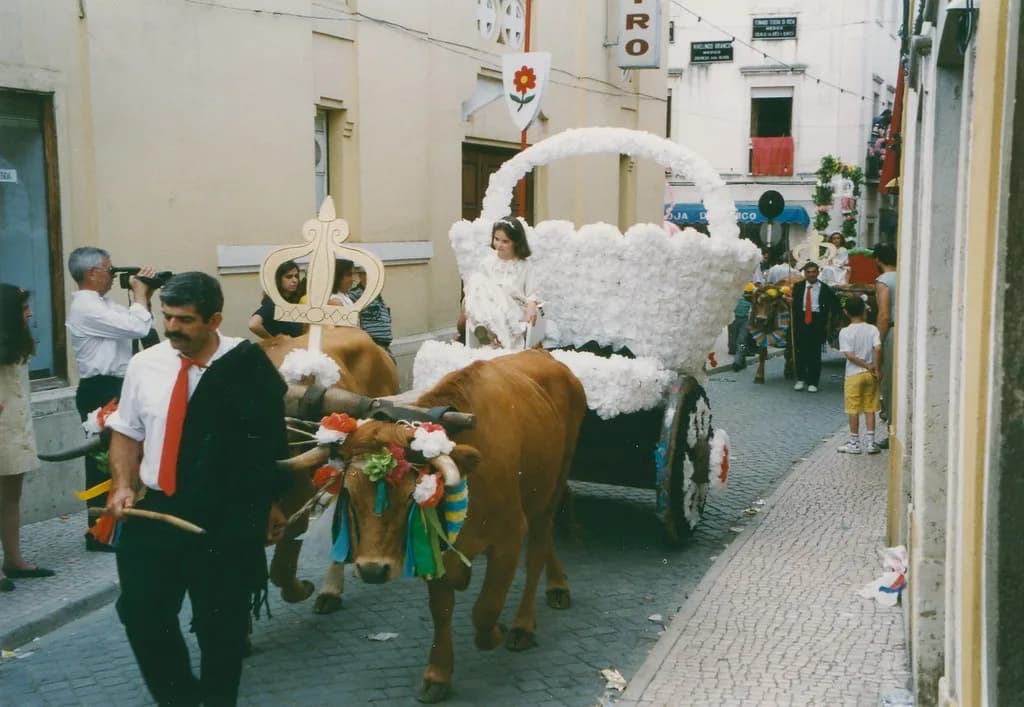
The Festa dos Tabuleiros, or Festival of the Trays, is a spectacular event held in Tomar, Portugal, only once every four years. It is a vibrant celebration where young women parade through the streets carrying towering trays of bread and flowers on their heads. This festival is a profound expression of faith and community, deeply rooted in the cult of the Holy Spirit.
For those planning a trip, it’s a once-in-a-lifetime experience. However, securing accommodation is a major challenge as rooms are very scarce across the entire region during the festival dates. This guide outlines the festival’s significance, its schedule, and essential practicalities to help you plan your visit.
What is the Festa dos Tabuleiros?
The Festa dos Tabuleiros is a traditional festival that takes place in Tomar, in central Portugal, every four years. The key moment is the Tabuleiros Parade, in which young women dressed in white carry on their heads platters called tabuleiros, which can be as tall as they are. These are made of around thirty loaves of bread threaded onto rods, decorated with paper flowers, wheat, and topped with a dove symbolizing the Holy Spirit.
The festival is a unique model within Portuguese festivities honoring the Holy Spirit. It involves all the parishes of the municipality and features several processions and complementary events, including the Boys' Parade, the Butler's Parade, and the decorative Ruas Ornamentadas (Ornamented Streets).
When does the Festa dos Tabuleiros take place?
The Festa dos Tabuleiros occurs every four years in the city of Tomar. The next edition is scheduled for July 3-12, 2027, as per official information. Previous editions have been held in 2023 and 2019.
The festival has a complex calendar that starts on Easter Sunday with the Parade of the Crowns and culminates in a 10-day cycle between the last weekend of June and the first of July. A detailed schedule for 2027 is not yet published, so it's best to check the official website closer to the date for specific days and times.
The Symbolism: Trays, Bread, and the Holy Spirit
The festival is deeply religious, honoring the Holy Spirit, with traditions dating back to the 14th century. Queen Isabel founded the Brotherhood of the Holy Spirit to gather donations for the poor, and the festival was co-opted by this Brotherhood. The trays represent the fulfillment of promises to the Divine, and the dove on top symbolizes the Holy Spirit and universal fraternity.
The bread loaves are a symbol of the harvest and the offerings to the Holy Spirit. In the past, in a tradition that ended in 1966, oxen were sacrificed and their meat distributed; now they serve only as a symbol in the processions. The distribution of food, known as the Pêza, continues this legacy of sharing.
The Processions and Ceremonies
The festival features a series of processions throughout its cycle. On Easter Sunday, the Parade of the Crowns leaves from all parishes, accompanied by bagpipers, drummers, and philharmonic bands. This parade is repeated seven times, with the crowns and banners being placed around the altars at the churches of São João Batista and Santa Maria dos Olivais.
On the Sunday of the 10-day cycle, the Boys' Parade and Games take place, exclusively involving children. During the following week, the Ornamented Streets open on Thursday, and the Butler's Parade takes place on Friday. On Saturday, there are Partial Parades and Popular Games.
The Main Parade of the Trays
The highlight of the festival is the Main Parade of the Trays, held on the Sunday afternoon. Girls in white with colorful sashes carry the towering tabuleiros on their heads, a breathtaking spectacle of color and faith. The parade ends with a blessing in Praça da República, in front of the Church of São João Batista.
Following the girls and their escorts, priests carry silver crowns, and the parade features horse and chariot cavalcades. The streets are decorated with flower tapestries, creating a stunning backdrop for the procession.
Other Events and Activities
Beyond the main parade, visitors can enjoy several complementary events. The Ruas Ornamentadas, or ornamented streets, are a must-see, with residents decorating their streets with flowers, quilts, and other adornments. The Cortejo dos Rapazes (Boys' Parade) and the Jogos Populares (Popular Games) provide a more local, communal atmosphere.
The Pêza, which takes place on the Monday, is a significant event where food is distributed to the community, continuing the festival's tradition of charity. This marks the closing of the festivities, so plan to stay until the end to experience this aspect.
History and Origins
The festival has roots in ancient pre-Roman fertility rituals, possibly related to the goddess Ceres. It was later co-opted in the 14th century by the Brotherhood of the Holy Spirit in Tomar. Some traditions attribute its creation to King Dinis and Queen Isabel.
Over the centuries, the festival evolved while maintaining its core religious symbolism. A significant change came in 1966 when the practice of sacrificing oxen was discontinued; the oxen are now purely symbolic. For a more detailed account, you can read about the history and traditions of the Festa dos Tabuleiros.
How to Plan Your Visit
Given the festival's rarity and popularity, accommodation is extremely scarce. It is essential to book your stay well in advance, ideally a year or more ahead, to secure a room in Tomar or nearby towns. The entire duration of the festival sees high demand, so early planning is crucial.
To ensure a good view of the parade, consider purchasing tickets for grandstand seating, which offer a reserved spot. For more information on this, check our guide on Festa dos Tabuleiros tickets and grandstand seating. Also, remember that prices for these tickets are not officially released far in advance, so keep an eye on the official website.
When you visit, you’ll also want to explore the region, and it's worth checking out other festivals in Portugal if you plan a longer trip. For instance, the Santo António celebrations in Lisbon are a vibrant summer option.
Exploring Tomar and the Surrounding Region
Tomar is a historic town in central Portugal, famous for the Convent of Christ, a UNESCO World Heritage site that took 600 years to build. Other attractions include the Gothic church of São João Batista and a small Jewish museum. The festival is a great opportunity to combine a cultural visit with this unique event.
The surrounding region offers many sights. The pretty town of Constância, about 20 km south-east, marks the confluence of the Tagus and Zêzere rivers. A short drive east, you’ll find the Castle of Almourol, a fairy-tale fortress on an island in the Tagus. Consider extending your stay to explore these highlights.
Plan Your Visit
The Festa dos Tabuleiros is a remarkable and deeply meaningful celebration that offers a glimpse into Portuguese culture and faith. Attending this rare festival requires planning, especially regarding accommodation and tickets. Start your preparations early to secure your place at this unforgettable event.
For the most accurate and up-to-date information on dates, schedule, and tickets, always refer to the official website of the festival. Remember to book well in advance, as rooms are very scarce. With careful planning, you can experience one of Portugal's most spectacular traditions in the beautiful city of Tomar.
Related festival guides
Frequently Asked Questions
What is the Festa dos Tabuleiros?
The Festa dos Tabuleiros, or Festival of the Trays, is a traditional festival held in Tomar, Portugal, every four years. It features a parade where girls carry large trays of bread and flowers on their heads, honoring the Holy Spirit.
When is the Festa dos Tabuleiros?
The next Festival is scheduled for July 3-12, 2027. The festival occurs every four years, with the previous edition in 2023.
How often is the Festa dos Tabuleiros celebrated?
It is celebrated once every four years in the city of Tomar. The exact dates can vary, so it's advisable to check the official website for the specific year.
What are tabuleiros?
Tabuleiros are the trays carried by girls in the main parade. They consist of thirty loaves of bread on rods, decorated with paper flowers and wheat, and are often topped with a dove.
Where does the Festa dos Tabuleiros take place?
The festival takes place in Tomar, a historic town in central Portugal, known for its Convent of Christ and rich Templar history.


